 Jun, 21 2026
You’ve probably seen it happen at the counter. A patient hands over a prescription for a brand-name drug, expecting that specific bottle. You swap it for the generic version to save them money, but then comes the hesitation. Is this really equivalent? Will it work the same way? This moment of doubt is exactly why staying current on generics isn’t just a box-checking exercise for your license-it’s a critical safety net for your patients.
Generic medications make up roughly 90% of all prescriptions dispensed in the United States today. Yet, they account for only about 23% of total drug spending. That massive volume means you are handling these drugs constantly. The problem is that the landscape around them changes fast. Between new approvals, shifting regulatory rules, and the rise of complex biosimilars, relying on what you learned in pharmacy school five or ten years ago is risky. Continuing Pharmacy Education (CPE) focused specifically on generics is how you bridge the gap between textbook theory and real-world practice.
Why Generic Knowledge Expires Faster Than Other Topics
Most pharmacists know they need CPE hours to renew their licenses. In most states, that means 15 to 30 hours every two years. But not all hours are created equal when it comes to competence. The Accreditation Council for Pharmacy Education (ACPE) defines CPE as structured activity designed to maintain and enhance competence. For generics, that competence has a short shelf life.
Consider the FDA Orange Book. It lists therapeutic equivalence ratings for approved drug products. These ratings tell you if a generic can be substituted for the brand name. The FDA updates this book monthly. As of recent data, there are over 1,200 therapeutic equivalence ratings in play. If you aren’t reviewing these updates, you might miss a change where a generic was downgraded from 'AB' (bioequivalent) to 'BX' (not bioequivalent) due to new clinical evidence. Dr. John Smith, a Professor of Pharmacy Practice at the University of Illinois College of Pharmacy, notes that pharmacists must stay current on these monthly updates to ensure appropriate substitution practices. Ignoring them isn't just lazy; it's potentially dangerous.
The stakes are high. An ACPE compliance report from 2021 found that nearly 43% of pharmacy-related malpractice claims involved errors related to generic substitution or misunderstandings of therapeutic equivalence. When you treat CPE as a chore rather than a tool, you increase your liability. When you treat it as a survival skill, you protect your patients.
Navigating the Regulatory Maze: ANDA and Bioequivalence
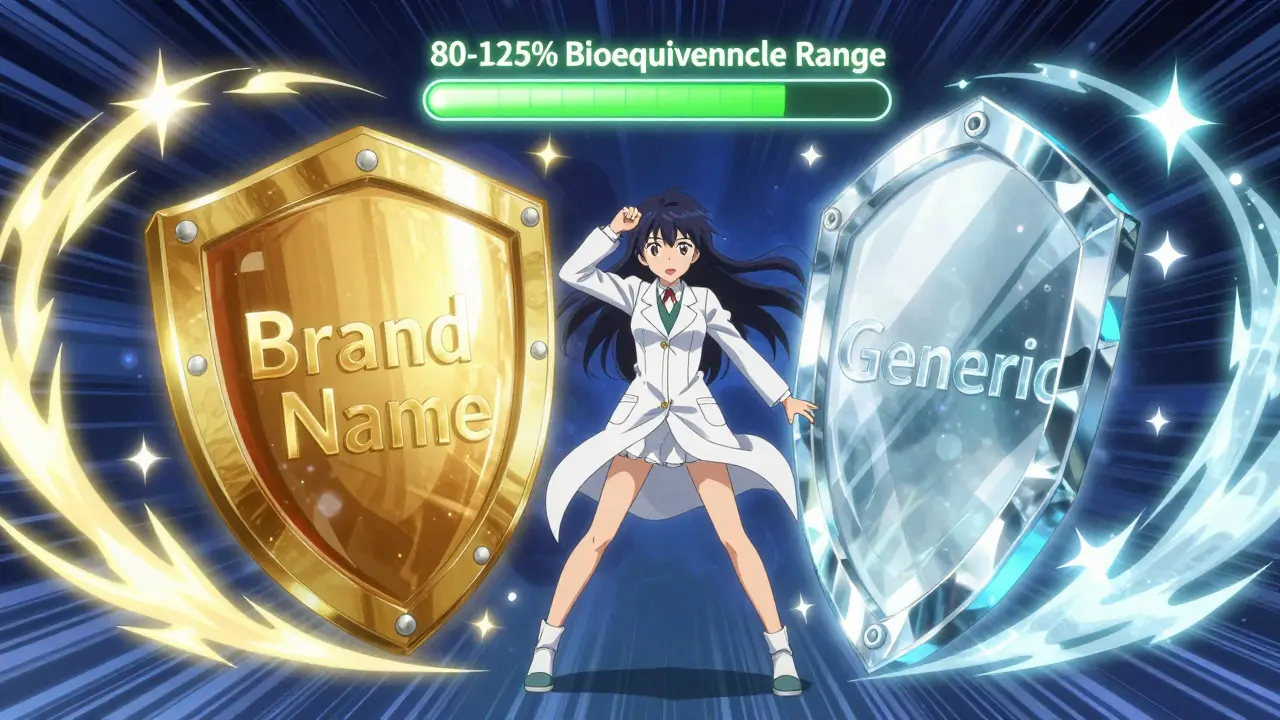
To understand generics deeply, you have to understand the Abbreviated New Drug Application (ANDA). Unlike a New Drug Application (NDA) for brand names, which requires extensive clinical trials, an ANDA relies on demonstrating bioequivalence. The FDA requires that a generic drug demonstrate bioequivalence within 80-125% of the brand-name drug’s pharmacokinetic parameters.
This 80-125% range often confuses patients. They think, "If it’s only 80% effective, why take it?" Your job is to explain that this range ensures the generic delivers the same amount of active ingredient into the bloodstream at the same rate as the brand. It’s not that the generic is weaker; it’s that the statistical confidence interval allows for minor variations that do not impact clinical efficacy. However, for Narrow Therapeutic Index (NTI) drugs-like levothyroxine, warfarin, or phenytoin-those minor variations matter much more. Many states now require specific CE training on NTI drugs because switching manufacturers for these meds can lead to therapeutic failure or toxicity.
Recent legislation like the CREATES Act (Creating and Restoring Equal Access To Equivalent Samples) has also complicated things. This law prevents brand companies from hoarding samples to block generic competitors from testing bioequivalence. While good for competition, it means more generics are hitting the market faster, sometimes with less head-to-head clinical data available immediately. You need to know how to read the labels and the Orange Book codes to spot potential issues before they reach the patient.
| Feature | Brand Name (NDA) | Generic (ANDA) |
|---|---|---|
| Approval Basis | Full clinical trials for safety/efficacy | Bioequivalence to reference listed drug |
| Bioequivalence Range | N/A (Reference Standard) | 80-125% of pharmacokinetic parameters |
| Therapeutic Equivalence Code | Not applicable (Reference) | 'AB' = Substitutable; 'BX' = Not substitutable |
| Sample Access | Manufacturer controls supply | Protected by CREATES Act provisions |
The Rise of Biosimilars: A New Frontier for CE
If small-molecule generics were tricky, biosimilars are a whole other beast. Biosimilars are biological products highly similar to an already approved reference biologic. Because biologics are made in living systems, they cannot be identical copies-they can only be 'highly similar.' This nuance is where many pharmacists stumble.
A 2023 survey by the American Society of Health-System Pharmacists (ASHP) revealed that 78% of hospital pharmacists felt they needed additional training on biosimilars. The confusion usually centers on interchangeability. Just because a biosimilar is approved doesn’t mean it’s automatically interchangeable under state law. Interchangeability is a separate designation given by the FDA after additional studies show that switching back and forth between the biosimilar and the reference product won’t pose increased safety risks.
As of January 1, 2025, ACPE announced new standards requiring all generics-related CE to include specific content on biosimilars interchangeability and Risk Evaluation and Mitigation Strategies (REMS) programs. This is a direct response to the complexity. If you are working in a specialty pharmacy or an oncology setting, ignoring biosimilar CE is no longer an option. You need to understand the cold chain requirements, the reconstitution processes, and the legal frameworks for substitution in your specific state.
Choosing the Right CPE Format: Knowledge vs. Application
Not all continuing education is useful. We’ve all sat through those dry, lecture-style modules that put us to sleep. But when it comes to generics, passive learning often fails. Pharmacists prefer application-based courses. Data from user reviews on platforms like CE21 shows that application-based courses with case studies receive significantly higher ratings (4.7/5 stars) compared to knowledge-based courses (3.2/5 stars).
Why? Because generic substitution is a decision-making process, not just a fact-recall task. An application-based course might present a case study: "Patient X is on levothyroxine from Manufacturer A. Their TSH levels are stable. Manufacturer B is now the preferred generic on the formulary. Do you switch? What do you monitor?" This forces you to apply the 80-125% rule, consider NTI status, and plan for patient counseling.
Providers like Pharmacist’s Letter offer free ACPE-accredited modules that focus on these practical scenarios. They cover ethics in pharmacy law and therapeutic substitution considerations. Wolters Kluwer provides specialized content on USP Chapters 795, 797, and 800, which is crucial if you handle compounding generics that require special handling. Look for courses that force you to think, not just click 'Next.'

State-Specific Hurdles and Compliance
One size does not fit all in pharmacy regulation. While ACPE sets national standards, your state Board of Pharmacy (BOP) dictates your license renewal. Illinois, for example, requires 30 hours of CE per cycle, including specific topics like Sexual Harassment Prevention and Implicit Bias Awareness. Starting in 2025, Illinois also mandates Cultural Competency training.
But look closer at generics-specific laws. Texas has unique substitution rules for narrow therapeutic index drugs. California requires pharmacists to maintain CE records for two years, while New York requires submission of certificates with renewal applications. If you hold multiple state licenses, you face a compliance nightmare. You must satisfy the strictest requirement of each state. This is where strategic planning matters. Don’t wait until the last week of your cycle. Map out your state requirements early in the year.
The National Association of Boards of Pharmacy (NABP) is working on a strategic plan to enhance consistency in generics education requirements across state boards, aiming for 80% alignment by 2025. Until then, you are the one who has to keep track. Use digital tools to log your hours and categorize them by topic. Ensure that your generics CE covers both the federal FDA regulations and your state’s specific substitution statutes.
Future-Proofing Your Practice
The industry is moving toward AI-powered personalized CE. By 2027, analysts predict that AI-driven platforms will hold 35% of the market share. These tools use algorithms to identify your specific knowledge gaps. If you struggle with biosimilar interchangeability, the system pushes relevant content to you. If you’re strong in oral solids but weak in injectable generics, it adjusts accordingly.
Early pilot programs, like those at CVS Health, have shown that integrating just-in-time learning interventions with point-of-care decision support can reduce generics-related errors by 28%. Imagine getting a quick pop-up reminder about a specific generic’s NTI status right when you are verifying the script, backed by a micro-learning module you completed that morning. That is the future of pharmacist education.
Until that technology is fully ubiquitous, you must take charge. Dedicate at least 5 hours annually to generics-specific CE, even if your state doesn’t explicitly require it. Review the Orange Book monthly. Engage with case studies. Talk to your colleagues about difficult substitutions. Staying current on generics isn’t just about keeping your license; it’s about maintaining the trust your patients place in you every time they pick up a prescription.
How many CE hours do I need for generics specifically?
There is no single federal mandate for generics-specific hours. However, the average pharmacist spends only about 5.2 hours annually on generics and therapeutics. Experts recommend dedicating at least 5-10 hours annually to targeted generics education, especially if you handle Narrow Therapeutic Index (NTI) drugs or biosimilars. Check your state board’s specific requirements, as some states like Texas have unique mandates for NTI training.
What is the difference between bioequivalence and therapeutic equivalence?
Bioequivalence refers to the similarity in the rate and extent of absorption of the drug (the 80-125% rule). Therapeutic equivalence is a broader designation found in the FDA Orange Book. An 'AB' rating means the generic is bioequivalent and expected to perform identically to the brand in terms of safety and efficacy. A 'BX' rating means it is bioequivalent but may differ in dosage form, strength, route of administration, or labeling, making it not suitable for automatic substitution.
Are biosimilars considered generics?
Are biosimilars considered generics?
Technically, no. Biosimilars are distinct from traditional small-molecule generics. Generics are chemical copies of brand drugs, while biosimilars are biological products that are highly similar to a reference biologic. They undergo different approval pathways (BLA vs. ANDA) and have different interchangeability rules. Because of this complexity, ACPE now requires specific CE content on biosimilars separate from traditional generics.
Which CE providers are best for generics training?
Look for ACPE-accredited providers that offer application-based learning. Pharmacist’s Letter offers free modules on ethics and substitution. Wolters Kluwer provides deep dives into compounding and handling. Platforms like CE21 and PocketPrep are popular for their user-friendly interfaces and case-study formats. Always verify that the provider is accredited by ACPE or your state Board of Pharmacy.
How often does the FDA Orange Book update?
The FDA Orange Book is updated monthly. These updates can include new approvals, changes in patent information, and shifts in therapeutic equivalence ratings. For pharmacists dealing with complex generics or NTI drugs, checking these updates regularly-or setting up alerts-is crucial for avoiding substitution errors.