 Feb, 19 2026
Buying medicine should be simple. You get a prescription, fill it at the pharmacy, and take it as directed. But what if the pill in your hand isn’t what it claims to be? Counterfeit medications are more common than most people realize - and they can kill you. The World Health Organization estimates that counterfeit drugs cause at least 500,000 deaths each year from diseases like malaria and pneumonia alone. These aren’t rare outliers. They’re a growing global crisis, and the signs are often right in front of you - if you know what to look for.
Pricing That’s Too Good to Be True
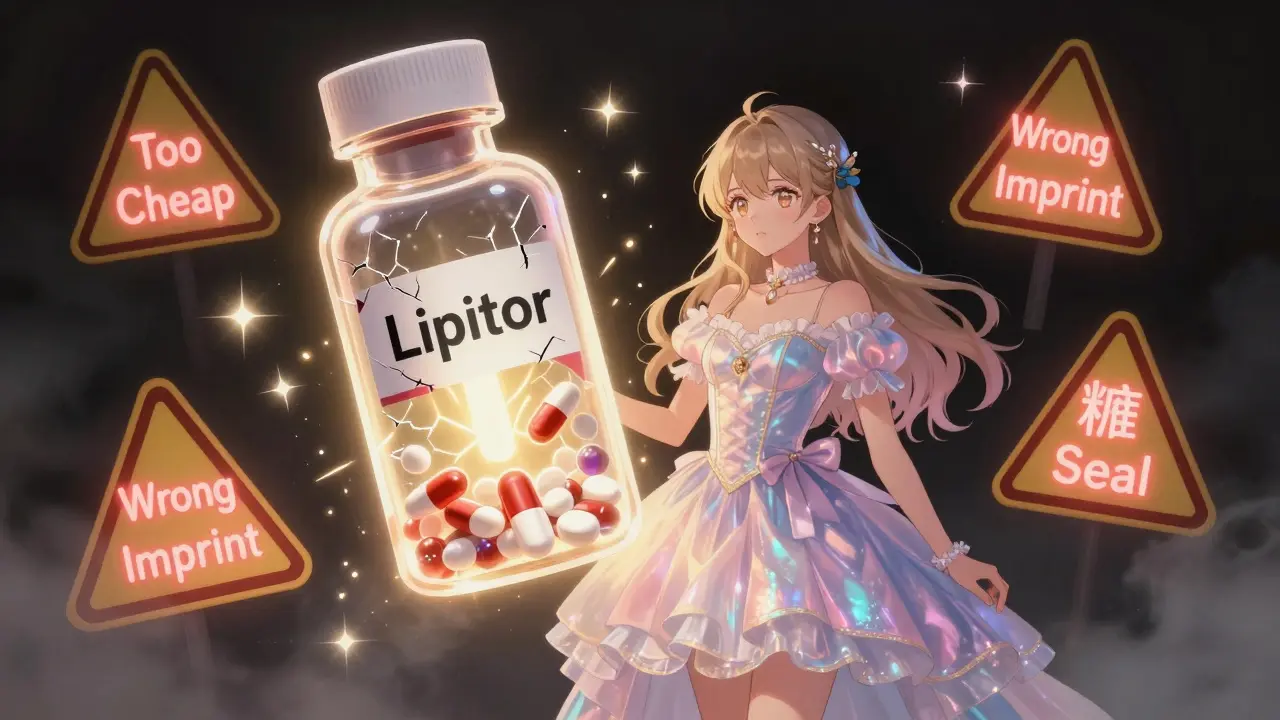
If a medication costs half (or less) than what you’d pay at a local pharmacy, run. Legitimate pharmaceutical companies don’t slash prices by 50% to 80%. That’s not a discount - that’s a red flag. According to Truemed’s 2024 industry analysis, any discount over 20% below market rate should raise suspicion. The DEA’s Operation Press Your Luck in September 2024 found that nearly all counterfeit pills sold online were priced at 60-80% below retail. The cheapest option isn’t the smartest. A 2024 Consumer Reports survey showed that 87% of medications bought from websites offering prices 60% below retail were fake. And those fake pills? They often contain deadly substances like fentanyl.Packaging That Doesn’t Add Up
The packaging is the first place counterfeiters slip up. Look closely. Spelling errors? That’s a major clue. The FDA’s 2023 database found that 63% of counterfeit drugs had misspelled words - like "Lipitor" labeled as "Lipitor" or "metformin" printed as "metformen." Missing or mismatched batch numbers? That’s another 41% of cases. Expiry dates that look smudged, printed in the wrong spot, or don’t match the manufacturer’s format? That’s 37% of fakes. Even the font might be off. Legitimate manufacturers use precise, high-resolution printing. Counterfeiters use cheap inkjet printers. Hold the box up to the light. If the text looks blurry or pixelated at 10x magnification, it’s fake. And don’t forget the seal. Tamper-evident seals should show clear damage if opened. If it looks like someone resealed it with tape or glue, walk away.What the Pill Looks Like
The pill itself can tell you everything. Legitimate tablets have strict manufacturing standards. They should be uniform in size, shape, and color. The weight shouldn’t vary more than 5%. The diameter? Within 2%. If your pills look different from the last refill - smaller, oddly shaped, or a slightly different shade - that’s a warning. Look for cracks, bubbles, or flaking coatings. Legitimate tablets don’t crumble in your fingers. And don’t just rely on color. Counterfeiters now use AI to match Pantone color codes perfectly. But they can’t replicate the exact embossing. Pfizer’s 2023 guide says even microscopic differences in the imprint - like a slightly deeper "M" or a misaligned line - can mean a fake. Dr. Theresa Michele from the FDA once said, "Even microscopic differences in embossing patterns can indicate counterfeits." That’s not something you see on a Google image search.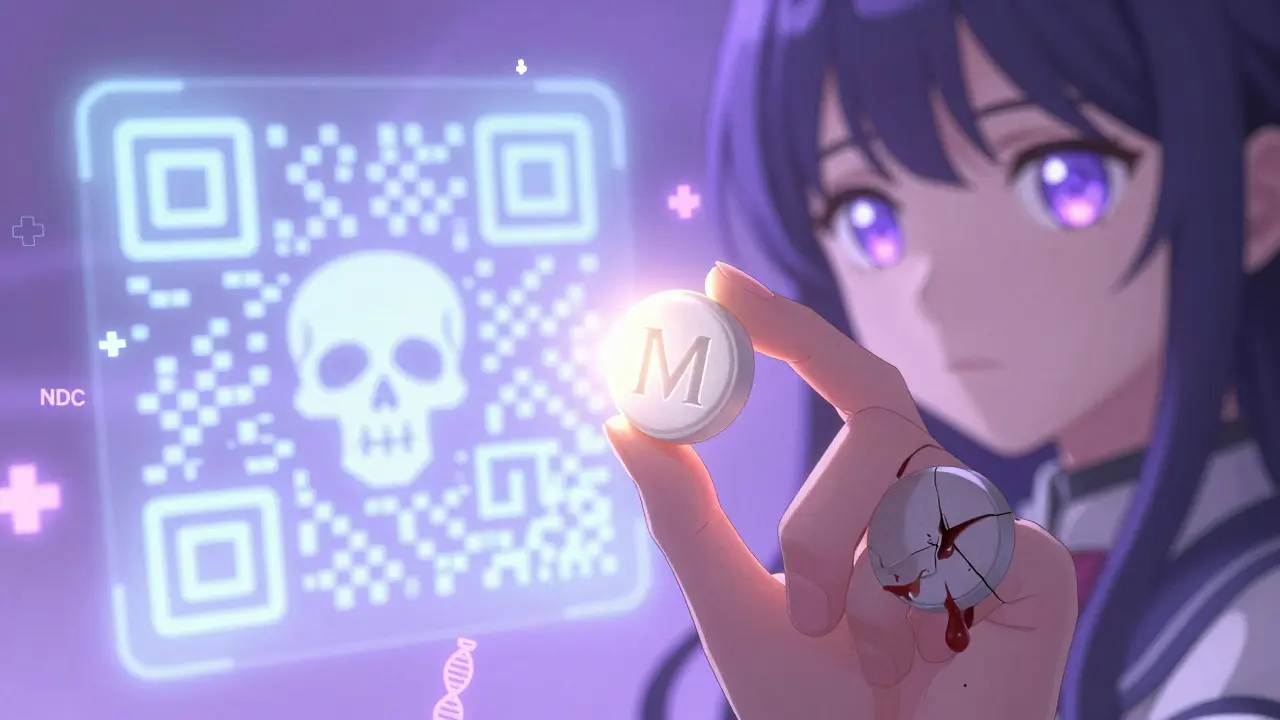
What Happens When You Take It
This is where it gets dangerous. You take the pill, and something feels off. Maybe you feel dizzy, nauseous, or have a sudden drop in blood sugar. That’s not a side effect - that’s poison. The DEA found that 22% of counterfeit pills contain completely wrong ingredients. In one case, fake Viagra from Hungary had amphetamine instead of sildenafil. In another, counterfeit metformin contained glyburide - a stronger diabetes drug that caused severe hypoglycemia in patients. A 2024 study in the Journal of Clinical Pharmacy and Therapeutics documented this exact scenario. Patients thought they were taking a glucose-lowering drug. Instead, they were getting a drug that dropped their blood sugar to life-threatening levels. And if you’re taking painkillers? The DEA’s Operation Press Your Luck found that 100% of counterfeit opioid pills contained fentanyl - at doses up to 2.3mg per pill. That’s nearly half a lethal dose. One pill can kill.Where You Buy It Matters
Never buy medication from a website that doesn’t require a prescription. That’s a hard rule. The FDA says 92% of verified counterfeit cases came from online pharmacies that skip this step. Even if the site looks professional - sleek design, fake reviews, a "doctor" on staff - if it doesn’t ask for your prescription, it’s illegal. The only safe online pharmacies have the .pharmacy domain. That’s not just a fancy suffix. It’s a verified seal from the National Association of Boards of Pharmacy (NABP). As of January 2025, only 6,214 websites had this certification. Meanwhile, Interpol identified over 35,000 illegal online pharmacies in 2024. If the site ends in .com, .net, or .xyz, and offers "discounted" pills without a script, it’s a trap. And don’t trust social media ads. A 2024 report showed that 40% of counterfeit drug sales now come from Instagram and Facebook posts.How to Verify Your Medicine
If you’re unsure, check these six things:- Check the seal. Tamper-evident packaging should be intact. If it looks resealed, don’t take it.
- Verify the NDC code. Every drug has a National Drug Code. Look it up on the FDA’s National Drug Code Directory - updated weekly.
- Call the manufacturer. Use the number on the box to confirm the lot number. Pfizer says 37% of counterfeit lot numbers don’t exist in their system.
- Compare the pill. Visit the manufacturer’s website. Most top 200 drugs have reference images showing exact size, color, and imprint.
- Do a solubility test. Put the pill in a glass of water. Legitimate tablets take at least 30 minutes to dissolve. If it breaks apart in 2 minutes, it’s fake.
- Report it. If you suspect a counterfeit, report it to FDA MedWatch within 24 hours. Your report could save someone else’s life.
The Hidden Threats You Can’t See
Some fakes look perfect. They use holograms, UV ink, even QR codes. But they still fail under scrutiny. The WHO’s 2024 report found that 95% of counterfeit holograms look real to the naked eye - but under 50x magnification, they lack the proprietary microtext that real manufacturers embed. Newer counterfeits even mimic the exact weight and size of real pills. But they still can’t replicate the precise chemical composition. A 2023 study in the Journal of Pharmaceutical Sciences showed that 98.7% of fake antimalarial pills failed disintegration tests - meaning they never released the active ingredient. So you took a pill, felt nothing, and thought it wasn’t working. It wasn’t the disease. It was the fake.And now, AI is making it worse. Deepfake packaging can fool 68% of consumers on first glance. The FDA’s new "PharmMark" system, launching in 2026, will use invisible nanoparticles that glow under UV light. But until then, you have to be your own first line of defense.
What to Do If You’ve Taken a Fake
If you suspect you’ve taken a counterfeit drug, stop immediately. Don’t flush it. Keep the pill, the bottle, and the receipt. Call your doctor. Report it to the FDA. And if you’re on a life-saving medication - like insulin, heart pills, or seizure drugs - get a new prescription right away. Fake insulin has caused diabetic ketoacidosis. Fake blood pressure pills have led to strokes. These aren’t myths. They’re documented cases.How can I tell if my medication is counterfeit just by looking at it?
Check for spelling errors on the label, mismatched batch or expiry dates, blurry printing, or packaging that looks cheaper than previous refills. Look at the pill itself - if it’s a different color, shape, size, or has cracks or flaking, it could be fake. Compare it to the manufacturer’s official images online.
Can counterfeit pills be dangerous even if they look real?
Yes. Many counterfeit pills look identical to the real thing but contain dangerous substances like fentanyl, amphetamine, or no active ingredient at all. A 2024 DEA report found that 100% of counterfeit opioid pills tested contained fentanyl at lethal doses. Even if the pill looks perfect, it can still kill you.
Are online pharmacies always unsafe?
No - but only if they have the .pharmacy domain and require a valid prescription. As of January 2025, only 6,214 websites were verified by the NABP. Over 35,000 illegal online pharmacies operate without oversight. If a site doesn’t ask for your prescription, it’s not safe.
Why do counterfeiters target certain drugs?
Counterfeiters target high-cost, high-demand drugs with big profit margins. In 2024, the most counterfeited drugs included erectile dysfunction meds (like Viagra), weight loss drugs (like Ozempic), and specialty biologics (like Humira). These drugs can cost over $1,000 a month, making them lucrative targets for fraud.
What should I do if I find a counterfeit medication?
Stop using it immediately. Keep the packaging and pills. Report it to the FDA through MedWatch within 24 hours. Contact your pharmacist or doctor to get a replacement. Your report helps track these operations and protects others.
Is it safe to buy medication from other countries?
Not unless you’re certain of the source. Medications from unregulated international sources may not meet U.S. safety standards. Even if they look identical, they could be counterfeit, expired, or improperly stored. The FDA does not approve drugs imported from foreign online pharmacies.
James Roberts
February 20, 2026 AT 11:14Wow. Just... wow. I had no idea counterfeit meds were this rampant. I thought it was just a third-world problem, but now I’m paranoid about every pill I’ve ever taken. I just checked my blood pressure meds-no spelling errors, seal is intact, NDC matches FDA’s site. Still, I’m calling my pharmacist tomorrow. Better safe than dead, right? 😅
Danielle Gerrish
February 21, 2026 AT 08:37Okay, I’m not exaggerating when I say this might be the most terrifying thing I’ve read all year. I’ve been buying my diabetes meds online because my insurance won’t cover the copay, and now I’m literally shaking. What if I’ve been taking fentanyl all this time and just thought I was tired? I’ve had dizzy spells for months. I’m not sleeping tonight. I’m going to the ER first thing in the morning. My kids need their mom. I’m not ready to go. I’m not ready. I’m not ready.
Liam Crean
February 22, 2026 AT 15:44Good breakdown. I’d add one thing: don’t trust the ‘look’ alone. I’ve seen counterfeit insulin that was flawless in packaging and pill imprint. What tipped me off was the solubility test. Real insulin dissolves slowly, like a sugar cube in tea. The fake one? It just vanished in 45 seconds. I tested it with a glass of water and a spoon. It’s dumb, but it works. Also-never trust a ‘doctor’ on a website who doesn’t have a verifiable license number. I’ve seen fake ones with .edu domains. Yeah, really.
Irish Council
February 23, 2026 AT 11:03Jayanta Boruah
February 23, 2026 AT 15:41It is imperative to underscore that the prevalence of counterfeit pharmaceuticals constitutes a systemic failure of global regulatory architecture. The World Health Organization's data, while statistically robust, underrepresents the true magnitude of the crisis due to underreporting in developing economies. Furthermore, the economic incentives for counterfeiters are exacerbated by intellectual property enforcement gaps, particularly in jurisdictions where patent litigation is prohibitively expensive. One must also consider the role of international logistics networks, which facilitate the clandestine distribution of substandard medications through porous border controls. The solution lies not in individual vigilance, but in multilateral regulatory harmonization.
Ashley Paashuis
February 25, 2026 AT 01:24Thank you for this comprehensive and life-saving guide. I’ve shared it with my elderly parents, who buy their medications from a local online vendor because they find it easier than driving to the pharmacy. I’m taking them to their doctor tomorrow to get a new prescription and verify everything. It’s scary how easily we assume safety. This post has given me clarity-and a renewed sense of responsibility.
Oana Iordachescu
February 25, 2026 AT 15:18And yet… what if the real drugs are just as dangerous? The FDA approves drugs that kill. The pharmaceutical industry funds research. The same companies that make the pills also lobby against transparency. The .pharmacy domain? A marketing ploy. The real solution? Decriminalize all drugs and regulate them like alcohol. No more profit motive. No more black market. No more fentanyl in fake pills-because there’d be no fake pills. Just regulated, tested, labeled substances. Think about it.
Davis teo
February 25, 2026 AT 21:12I bought Ozempic online for $80 a month. It looked legit. I lost 15 pounds. Then I started sweating bullets at 3 a.m. and my heart felt like it was trying to escape my chest. I thought I was having anxiety. Turns out? It was glyburide. I was almost dead. I kept the bottle. I reported it. The FDA sent me a thank-you email. That’s it. No investigation. No arrest. Just… silence. Now I’m scared to take anything. Even aspirin.
Arshdeep Singh
February 26, 2026 AT 00:30You’re all missing the point. The real issue isn’t counterfeit pills-it’s the fact that we’ve allowed healthcare to become a commodity. People buy meds online because they can’t afford the real ones. So you blame the counterfeiters? No. You blame the system that makes desperation a business model. If insulin cost $10 instead of $1,000, would anyone risk a fake? Of course not. This isn’t about pills. It’s about capitalism. And capitalism is the real counterfeit.
madison winter
February 26, 2026 AT 08:42I read this. I’m tired now. Can we just agree that medicine is weird and scary and we all just need to stop thinking about it?
James Roberts
February 26, 2026 AT 13:57@7782: I feel you. But if you don’t think about it, you might not live long enough to not think about it. I’m printing this out and taping it to my medicine cabinet. Just in case.