 Jan, 15 2026
CYP450 Interaction Checker
Check if two medications you're taking interact through liver enzymes. Enter your medications below to see if they compete for the same metabolic pathway.
Interaction Results
Imagine taking two pills at the same time - one for your blood pressure, another for your depression - and not realizing they’re fighting over the same enzyme in your liver. That’s not a hypothetical. It’s happening to millions of people every day. The reason? CYP450 enzymes, the body’s main drug-processing system, are overwhelmed by the number of medications we take. These enzymes don’t work like a team; they work like a single toll booth during rush hour. Only one car can pass at a time. If two drugs arrive together, one gets stuck - and that can mean toxicity, treatment failure, or worse.
What Are CYP450 Enzymes, and Why Do They Matter?
CYP450 stands for cytochrome P450. These are proteins in your liver and intestines that break down drugs so your body can get rid of them. About 90% of all prescription medications rely on them. Think of them as the body’s primary detox crew. Without them, drugs would build up to dangerous levels. But here’s the catch: there are only a few major players. CYP3A4 handles half of all drugs - including statins, opioids, and blood thinners. CYP2D6 deals with a quarter, including many antidepressants and beta-blockers. CYP2C9, CYP2C19, CYP1A2, and CYP2E1 split the rest. That’s it. Six enzymes doing the work of hundreds of drugs.
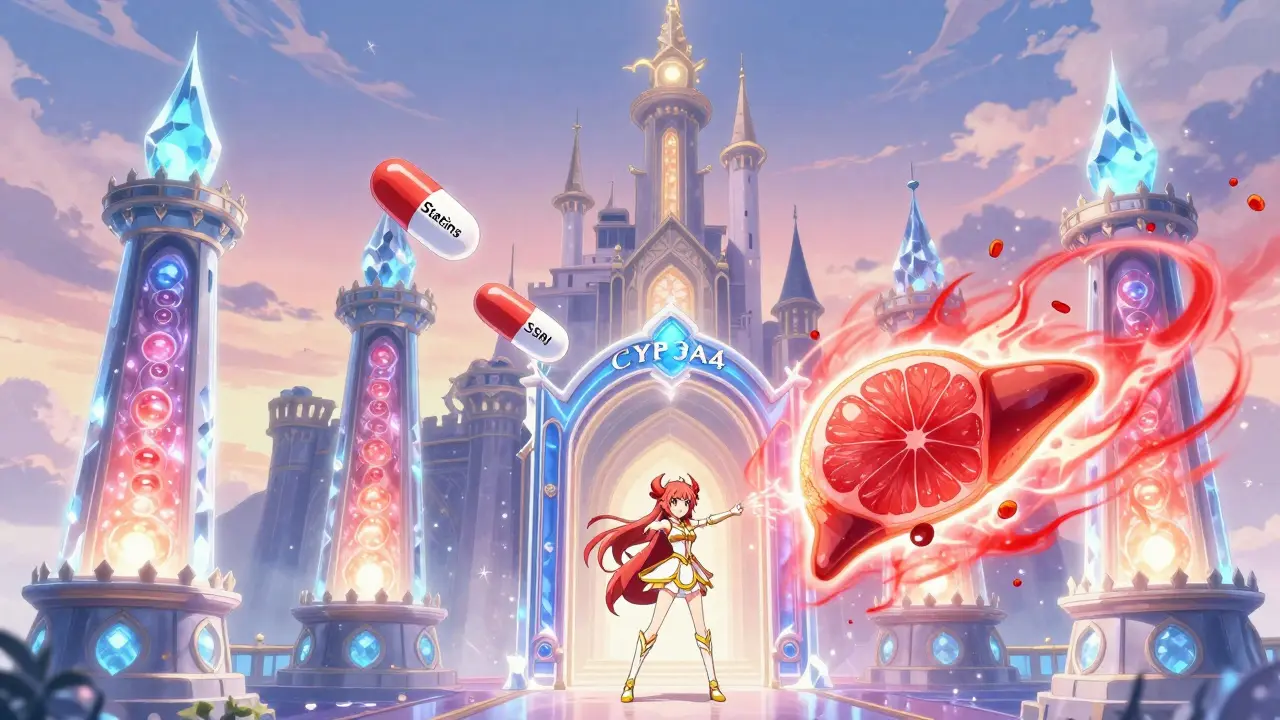
When you take a new medication, it doesn’t just enter your bloodstream - it enters a crowded waiting room. If it’s a substrate (a drug that needs to be broken down), it has to wait its turn. If another drug is already there - and it’s a strong inhibitor - it blocks the doorway. The result? The first drug builds up in your blood. For a drug like simvastatin, used to lower cholesterol, that can lead to muscle damage so severe it causes kidney failure. That’s not rare. It’s documented in case reports across hospitals.
How Do Drugs Compete? Inhibition vs. Induction
There are two ways one drug can mess with another’s metabolism: inhibition and induction. Inhibition is the most common. It’s like someone cutting in line. A drug like clarithromycin (an antibiotic) or fluoxetine (an antidepressant) latches onto CYP3A4 or CYP2D6 and won’t let go. This is reversible inhibition - the blocker is just sitting there, taking up space. But some inhibitors, like grapefruit juice, bind so tightly they permanently disable the enzyme. That’s why you’re told not to drink grapefruit juice with certain pills. One glass can knock out intestinal CYP3A4 by nearly half. That means your pill gets absorbed faster and stronger than intended.
Induction is the opposite. Instead of blocking, a drug like rifampin (used for tuberculosis) or St. John’s wort (a popular herbal supplement) tells your liver to make more enzymes. It’s like building a second toll booth. But here’s the problem: it takes days to kick in. If you start taking St. John’s wort while on birth control, you might not notice anything for a week. Then, suddenly, your pill stops working. You get pregnant. That’s not a myth. It’s happened to real people.
Who’s at Risk? The Real-World Cases
It’s not just about what you take - it’s about who you are. Your genes play a huge role. About 5-10% of white people are poor metabolizers of CYP2D6. That means their bodies barely break down drugs like codeine, tramadol, or metoprolol. For them, codeine doesn’t work at all - because it needs CYP2D6 to turn into morphine. Meanwhile, ultrarapid metabolizers (1-10% of people, depending on ancestry) turn codeine into morphine too fast. They get high, then crash. In one case, a mother breastfeeding while taking codeine for pain gave her baby a lethal morphine overdose because she was an ultrarapid metabolizer.
Then there’s clopidogrel, the blood thinner given after heart attacks. It’s a prodrug - meaning it’s inactive until CYP2C19 converts it. But 30% of Caucasians and 60% of Asians have a genetic variant that makes them poor converters. They get the drug, but it doesn’t work. They have another heart attack. The FDA now recommends testing for this before prescribing it. Yet, most doctors still don’t.
Nurses report that the most common interaction they see is between SSRIs like paroxetine and beta-blockers like metoprolol. Paroxetine blocks CYP2D6. Metoprolol needs it. The result? Slowed heart rate, dizziness, fainting. One nurse surveyed 1,200 colleagues - 15-20% of patients on this combo had these symptoms. Yet, it’s still prescribed together all the time.
The Silent Culprits: Herbs, Supplements, and Food
Most people know about drug-drug interactions. Few realize that supplements and food are just as dangerous. St. John’s wort? It’s a powerful CYP3A4 inducer. It can cut the levels of cyclosporine (used after organ transplants) by 60%. That means rejection. Grapefruit juice? It’s a CYP3A4 inhibitor. One glass can double the concentration of a statin. Orange juice? Safe. But grapefruit? Not even a splash.
Green tea? It can inhibit CYP3A4. Turmeric? May interfere with CYP2C9. Even over-the-counter antacids can change stomach pH and affect how drugs are absorbed. And nobody tells you this when you buy them at the pharmacy counter.
How Do You Protect Yourself?
There are three things you can do:
- Know your meds. Keep a list - all of them. Prescriptions, OTCs, vitamins, herbs. Bring it to every appointment.
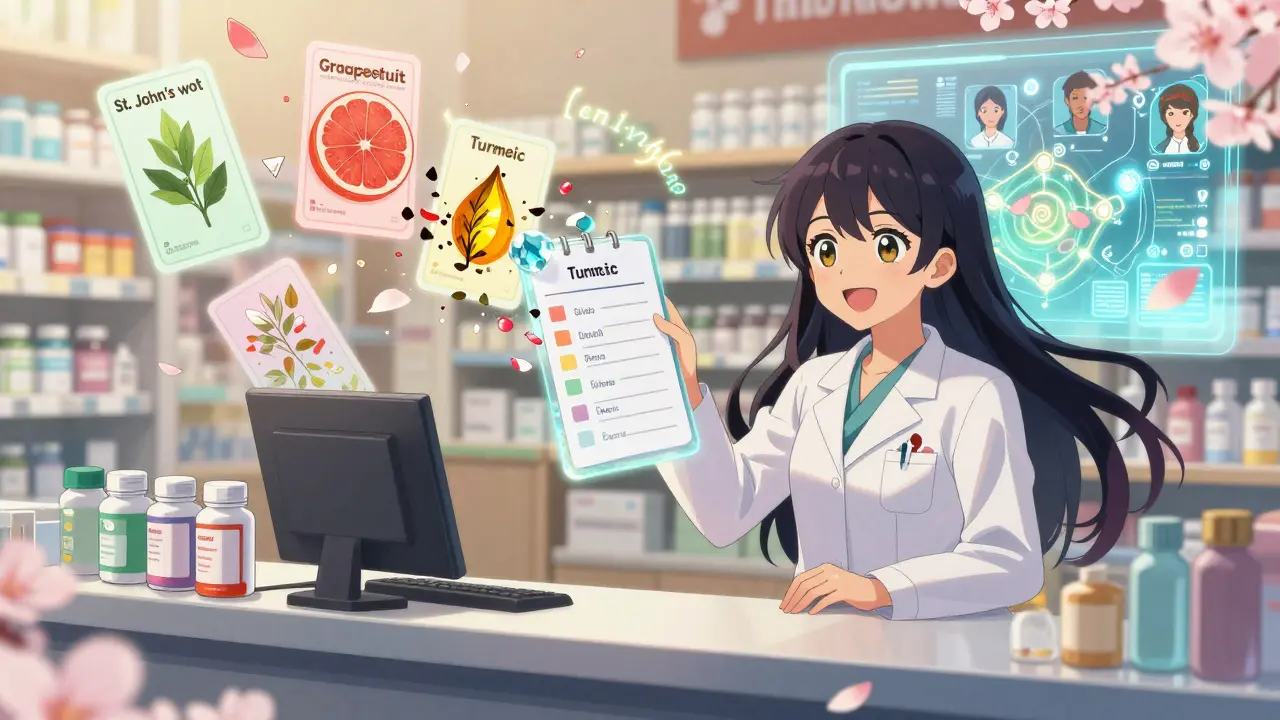
- Ask your pharmacist. Pharmacists are trained to spot these interactions. They have tools like Lexicomp that check every drug in your list against CYP450 databases. Ask them: “Could any of these be competing with each other?”
- Get tested if you’re on multiple drugs. Pharmacogenomic testing (which checks your CYP genes) costs $250-$500. Many insurance plans cover it if you’re on high-risk meds like antidepressants, blood thinners, or painkillers. The results can tell you if you’re a poor, normal, or ultrarapid metabolizer. That changes everything.
Hospitals with clinical decision support systems - software that flags interactions in real time - reduce adverse events by 35%. But outside hospitals? Most primary care doctors don’t check. Only 28% do it routinely. That means the burden falls on you.
The Future: AI, EHRs, and Better Warnings
The good news? Things are changing. By 2024, all major electronic health records - Epic, Cerner, Allscripts - now warn doctors about CYP450 interactions. IBM Watson’s AI system predicts these interactions with 89% accuracy. The NIH is standardizing gene names so results from different labs can be compared. The FDA now requires every new drug to be tested for CYP450 interactions before approval.
But the system still isn’t perfect. Over 30% of CYP gene variants remain unclassified. We don’t know what they do. And with the average Medicare patient taking 5.4 medications, the odds of a bad interaction are over 10 per person. That’s not a flaw - it’s a design problem. We’ve created a world where we pile on drugs without checking how they interact.
The solution isn’t to stop taking meds. It’s to take them smarter. If you’re on more than three medications, especially if they’re for chronic conditions, you need to treat CYP450 interactions like a serious risk - not an afterthought.
Can I still take grapefruit juice if I’m on medication?
Only if your medication isn’t affected by CYP3A4. If you’re taking statins like simvastatin, atorvastatin, or lovastatin; immunosuppressants like cyclosporine; or certain anti-anxiety drugs like buspirone - avoid grapefruit juice completely. Even a single glass can raise drug levels by 30-80%. For other drugs, check with your pharmacist. Orange juice, apple juice, and cranberry juice are safe alternatives.
Are herbal supplements safe to take with prescription drugs?
No, not without checking. St. John’s wort can make birth control, antidepressants, and transplant drugs fail. Goldenseal can inhibit CYP3A4 and CYP2D6. Garlic and ginkgo can interfere with blood thinners. Many people assume “natural” means safe, but herbs are potent. They’re not regulated like drugs, so their strength varies. Always tell your doctor or pharmacist what supplements you’re taking - even if you think they’re harmless.
Why does my antidepressant make my blood pressure medication less effective?
Many antidepressants - especially paroxetine, fluoxetine, and sertraline - are strong inhibitors of CYP2D6. If you’re taking a beta-blocker like metoprolol, carvedilol, or propranolol, which rely on CYP2D6 to break down, the antidepressant slows that process. The result? Higher levels of the beta-blocker in your blood. That can cause your heart rate to drop too low, leading to dizziness or fainting. Your doctor may need to switch you to an antidepressant that doesn’t affect CYP2D6, like citalopram or escitalopram.
If I have a genetic test, will it tell me everything I need to know?
Not everything - but it tells you a lot. A pharmacogenomic test can show if you’re a poor, intermediate, extensive, or ultrarapid metabolizer for key enzymes like CYP2D6, CYP2C19, and CYP3A4. That helps your doctor choose the right drug and dose. But it doesn’t predict interactions from food, herbs, or other drugs. You still need to review your full medication list with a pharmacist. Genetic testing is a tool, not a complete solution.
What should I do if I start a new medication and feel worse?
Don’t assume it’s just a side effect. If you started a new drug and began feeling unusually tired, dizzy, nauseous, or had muscle pain, it could be an interaction. Check if the new drug is a strong inhibitor or inducer of CYP450 enzymes. Look up your other meds and see if they’re substrates. Call your pharmacist. They can check for interactions in seconds. If you’re on a blood thinner, statin, or antidepressant, don’t wait - get it checked right away.
Final Thought: You’re Not Just a Patient - You’re the Manager
The system isn’t broken. It’s just too complex for anyone to manage alone. Doctors are overloaded. Pharmacists are underused. And patients are expected to know what’s safe. But you don’t need to be a scientist to protect yourself. You just need to be informed. Keep your meds list updated. Ask the pharmacist. Consider testing if you’re on multiple drugs. Don’t let CYP450 interactions become a silent killer. Your body is doing its best. You just need to give it the right tools to do the job safely.
brooke wright
January 16, 2026 AT 09:40I took simvastatin and grapefruit juice for years thinking it was fine until I ended up in the ER with rhabdo. Never again. My pharmacist had to literally scream at me to stop. Now I keep a list of every damn thing I take and cross-check it like my life depends on it - because it does.
Also, if you’re on blood thinners, don’t even think about turmeric supplements. I learned that the hard way.
Allen Davidson
January 17, 2026 AT 22:53This is one of those posts that should be required reading for anyone over 40. I work in primary care and see this every week - patients on 7 meds, no one’s talking to each other, and the pharmacist gets blamed when something goes wrong.
Doctors are drowning in paperwork. Pharmacists are stretched thin. And patients? They’re just trying to survive. We need better systems, not just more warnings.
Also, if you’re on clopidogrel and didn’t get tested? Ask for it. It’s not expensive, and it could save your life.
Rob Deneke
January 18, 2026 AT 06:42St John’s wort is a silent killer no one talks about. I put my mom on it for depression after her husband died. She was also on warfarin. One day she started bleeding out of nowhere. Turned out the herb cut her INR in half. She almost died. Now she’s on SSRIs and no more herbal crap. Natural doesn’t mean safe. Ever.
Also grapefruit juice is a trap. Don’t be that guy.
evelyn wellding
January 18, 2026 AT 23:36OMG YES THIS!! 😭 I’m on fluoxetine and metoprolol and kept getting dizzy and passing out. My doctor said it was ‘just anxiety’ for months. Finally went to a pharmacist - they looked at my meds and said ‘oh honey, you’re basically on a beta-blocker overdose.’ Switched to escitalopram and I’m back to life!!
PLEASE tell your doctor if you’re on SSRIs + heart meds. It’s so common it’s scary.
Also… grapefruit juice is not a breakfast friend anymore 🙈
Chelsea Harton
January 19, 2026 AT 04:05Corey Chrisinger
January 19, 2026 AT 17:18It’s wild how we treat our bodies like black boxes. We plug in meds like USB drives and expect them to just work. But our enzymes? They’re not machines. They’re biological gatekeepers with limited bandwidth.
And yet we keep adding more apps without checking compatibility. We’re not just patients - we’re accidental hackers of our own physiology.
Also, if you take St. John’s wort and birth control? You’re not just risking pregnancy. You’re playing Russian roulette with your hormones. 🤯
Bianca Leonhardt
January 21, 2026 AT 00:52Of course you’re getting side effects. You’re probably taking 12 supplements and 5 prescriptions and thinking you’re ‘being proactive.’ You’re not. You’re just a walking pharmacology disaster.
Stop drinking green tea with your statins. Stop taking ‘natural’ anything without checking. Stop assuming your doctor knows what you’re taking. They don’t. You’re the only one who cares enough to save yourself.
And if you think genetics don’t matter? You’re the reason hospitals have ICU beds full of people who ‘just took a little extra.’
Travis Craw
January 22, 2026 AT 02:14My dad died from a statin interaction. He was on simvastatin and took clarithromycin for a sinus infection. No one told him not to. He just followed the script.
After he passed, I started asking every pharmacist I met: ‘Is this combo safe?’ I’ve saved three friends since then. It’s not hard. Just ask.
And yeah, grapefruit juice? I don’t even buy it anymore. Not worth it.
Christina Bilotti
January 22, 2026 AT 09:30Wow. A whole 2000-word essay on something that should’ve been taught in high school biology. You know what’s worse than CYP450 interactions? People who think ‘natural’ supplements are safe because they come from plants. Like, what, the poison dart frog is ‘natural’ too? Should we start taking its venom as a ‘wellness tonic’?
Also, if you’re on more than three meds and haven’t had pharmacogenomic testing, you’re not being proactive - you’re being reckless. Get tested. Or don’t. But don’t cry when you end up in the hospital.
And yes, I know you’re ‘just taking one turmeric capsule.’ I’ve seen your chart.
Cheryl Griffith
January 22, 2026 AT 21:11I’m a nurse and I see this every day. A sweet 78-year-old lady on 8 meds, 5 supplements, and a glass of grapefruit juice every morning. She says ‘it’s just orange juice’ and I have to gently correct her. Again.
It breaks my heart because she’s trying so hard to feel better. But the system isn’t built for people like her. No one’s checking. No one’s connecting the dots.
Just please - write down every pill, every tea, every spoonful of turmeric. Bring it to your next appointment. Even if you think it’s ‘nothing.’ It’s everything.
Nick Cole
January 23, 2026 AT 22:55My cousin took clopidogrel after her stent. She had a second heart attack six months later. Turned out she was a poor metabolizer. The doc never tested her. She’s alive now, but she’ll never forgive herself for not asking.
Don’t be her. Ask. Even if it feels dumb. Even if your doctor rolls their eyes. You’re not being annoying - you’re being smart.
And yes, I got tested. Cost me $300. Worth every penny.
Henry Ip
January 25, 2026 AT 21:46Biggest takeaway? Don’t trust the label. Don’t trust the ad. Don’t trust ‘natural.’ Trust your pharmacist. They’re the only ones trained to look at your whole list and say ‘hey, this combo is a bomb waiting to go off.’
I used to think pharmacists just handed out pills. Now I know they’re the unsung heroes of modern medicine.
Also - grapefruit juice isn’t juice. It’s a chemical weapon against your liver. Treat it like one.
Kasey Summerer
January 26, 2026 AT 02:54Y’all in the US are wild. We take 10 pills, 7 supplements, and then blame ‘aging’ when we get sick. Meanwhile, in my village in Thailand, my abuela takes one herb, walks 5 miles a day, and doesn’t know what a statin is. She’s 92 and still makes kimchi.
Maybe we’re overmedicating ourselves into oblivion. Just saying. 🤷♂️
Also - grapefruit juice? No. Just no. Even if it’s ‘organic.’
kanchan tiwari
January 27, 2026 AT 10:19THIS IS A GOVERNMENT COVER-UP. The FDA knows CYP450 interactions kill thousands every year. But they let Big Pharma push more pills because profits > lives. They don’t want you to know about pharmacogenomics because then you’d stop buying their drugs.
They’re poisoning us with statins and antidepressants while hiding the truth behind ‘clinical trials.’
St. John’s wort is banned in some countries because it’s too effective. Why? Because it’s free. And free things don’t make money.
Wake up. The system is rigged. Your meds are weapons. Your pharmacist? They’re on their payroll.
Bobbi-Marie Nova
January 28, 2026 AT 03:05Okay but real talk - if you’re on more than three meds and haven’t talked to a pharmacist about interactions, you’re basically playing ‘Medication Roulette’ and expecting to win.
Also, I used to think grapefruit juice was ‘healthy.’ Now I drink orange juice and feel smug about it. 🍊😎
And yes, I got tested. My CYP2D6 is slow as molasses. Turns out I’m not ‘just sensitive’ - I’m genetically programmed to need half the dose. Mind blown.