 Jan, 18 2026
Switching to generic medications isn’t just a smart money move-it’s a life-changing decision for millions of Americans struggling to afford their prescriptions. You might think that cheaper means weaker, but that’s not how it works. The generic medications sitting on your pharmacy shelf are not knockoffs. They’re the exact same medicine, approved by the FDA, and backed by science. And they’re saving patients an average of 85% compared to brand-name drugs.
What Exactly Is a Generic Drug?
A generic drug contains the same active ingredient as its brand-name version. If you take lisinopril for high blood pressure, the generic version has the same molecule, the same dose, and the same effect as Zestril or Prinivil. The only differences? The color, shape, or filler ingredients-like starch or dye-that don’t affect how the drug works. Generic drugs are sold under their chemical name, not a catchy brand name. That’s why you see pills labeled "atorvastatin" instead of "Lipitor." The FDA doesn’t approve generics lightly. To get the green light, manufacturers must prove their version delivers the same amount of medicine into your bloodstream at the same speed as the brand-name drug. That’s called bioequivalence. The allowed range? Within 80% to 125% of the original. That’s not a wide margin-it’s tight enough to ensure your body responds the same way.How Much Money Are You Really Saving?
The numbers don’t lie. Over the last decade, generic medications saved U.S. patients more than $2.2 trillion. That’s not a guess. That’s a documented total from the Alliance for Patient Access. For individual prescriptions, the savings are dramatic. Take one blood pressure pill: the brand version cost $47 per dose. After a generic hit the market, it dropped to under $2. The monthly cost went from $1,400 to under $60. Another example: a cancer drug that used to cost $88 per milliliter? Generic versions brought it down to under $10. That’s a 90% drop. For a 30-day supply, that meant savings of $3,300 per patient. Even with insurance, the difference is huge. A 2023 study in JAMA Health Forum looked at 124 generic drugs and found that patients saved a median of $4.96 per prescription just by choosing generics over brand names. Uninsured patients saved even more-$6.08 on average. At Costco, 90% of the most common generic prescriptions cost less than $20 for a 30-day supply. That’s less than your daily coffee.Do Generics Work as Well as Brand Names?
This is the biggest concern people have. "Will it work the same?" The answer is yes-every time, for nearly everyone. The FDA requires generics to meet the same quality, strength, purity, and stability standards as brand-name drugs. The same factories, under the same inspections, can make both. In fact, many brand-name companies make their own generic versions after their patent expires. Some patients report feeling different on a generic. Maybe they feel more tired, or their symptoms aren’t as controlled. But in most cases, that’s not because the medicine is weaker. It’s because of the inactive ingredients-like binders or coatings-that can affect how the pill feels in your stomach or how quickly it dissolves. These don’t change how the drug works, but they can change your experience. There’s one exception: drugs with a narrow therapeutic index. These are medications where even a tiny change in blood levels can cause problems. Levothyroxine (for thyroid) is one. Some patients do better staying on the same brand or generic consistently. But even here, switching isn’t dangerous-it just needs monitoring. Your doctor can check your thyroid levels after the switch to make sure you’re still in the right range.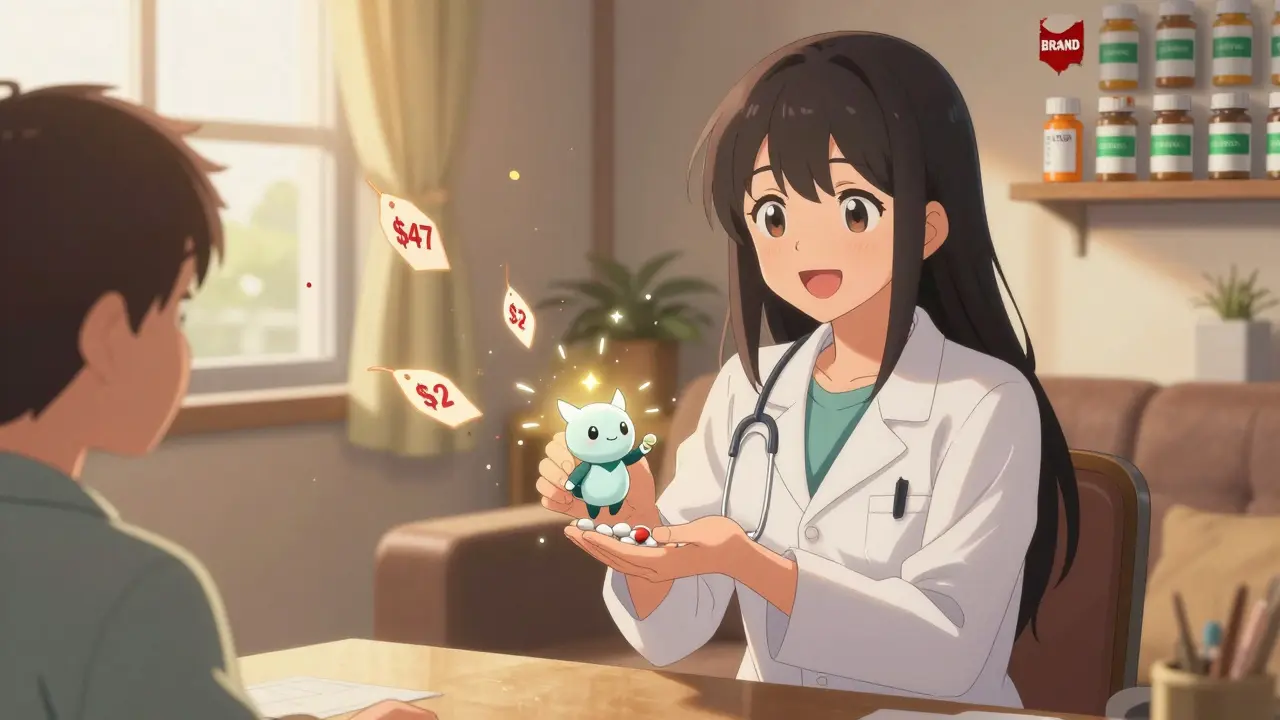
Why Aren’t More People Using Generics?
You’d think everyone would jump on this. But confusion, misinformation, and inertia hold people back. Some think generics are "second-rate" because they’re cheaper. Others don’t know they’re being prescribed a brand name when a generic is available. Pharmacists are legally allowed to substitute generics unless the doctor writes "Dispense as Written" or "Do Not Substitute." But many patients never ask. They just take what’s handed to them. Insurance formularies also play a role. Many plans have tiered copays: $5 for generics, $40 for brands. But sometimes, even when a generic exists, your plan doesn’t cover it unless your doctor files for prior authorization. That’s a hassle. And if you’re already overwhelmed managing your health, you might just stick with the brand to avoid the paperwork.How to Make Sure You’re Getting the Best Deal
You don’t need to be a pharmacy expert to save big. Here’s how to take control:- Ask your doctor: "Is there a generic version of this?" If they say no, ask why. Most drugs have one.
- Check your pharmacy’s cash price. Sometimes, paying out-of-pocket at Costco, Walmart, or Target is cheaper than using your insurance copay. A 30-day supply of metformin? $5 at Walmart. Same drug, same results.
- Try the Mark Cuban Cost Plus Drug Company (MCCPDC). Launched in 2022, it sells generics at transparent prices-no middlemen, no markups. You pay the cost of the drug plus a $3 fee. Many prescriptions cost under $10.
- Use GoodRx or SingleCare. These apps show real-time prices at nearby pharmacies. You can print or show a coupon at checkout-even if you have insurance.
- Don’t assume your insurance will save you money. Sometimes, it doesn’t. Always compare the cash price with your copay.
What About Biosimilars? Are They the Same?
Biosimilars are the next wave of cost savings, but they’re not exactly like generics. They’re for complex drugs made from living cells-like insulin, rheumatoid arthritis treatments, or cancer therapies. Because they’re made from biological sources, they can’t be copied exactly. But they’re designed to work the same way. The FDA approves them using strict standards, and studies show they’re just as safe and effective as the original biologic drugs. The good news? Biosimilars are starting to cut prices. For example, a biosimilar to the arthritis drug Humira can cost 50-70% less. More are coming. In 2026, several more biologics will lose patent protection, opening the door for even more savings.
Real Stories, Real Savings
Andrew Tighe from Phoenix switched his daughter’s medications to generics after she was diagnosed with a developmental disorder. Her monthly prescription costs dropped from $800 to $120. "We saved hundreds a year," he said. "It meant we could afford her therapy, her meals, her transportation. We didn’t have to choose between medicine and rent." On Reddit, users share stories like: "I take 5 different maintenance meds. Switching to generics cut my monthly drug bill from $620 to $110. I can finally afford to fill all my prescriptions without skipping doses." One woman on r/personalfinance posted: "My brand-name antidepressant was $150 a month. Generic? $4. I didn’t feel any different. My mood stayed stable. My bank account improved." These aren’t rare cases. They’re the norm.What’s Holding Back Even More Savings?
The system isn’t perfect. The FDA has a backlog of hundreds of generic applications waiting approval. That delays competition. Fewer competitors mean slower price drops. The Alliance for Patient Access says clearing that backlog could save patients another $100 billion a year. Also, some manufacturers consolidate. When only one company makes a generic for a popular drug, prices can spike. That happened with doxycycline and penicillin in recent years. But when multiple companies enter the market, prices crash. That’s how we got from $47 to $2 per pill. The solution? More competition. More transparency. More awareness.Bottom Line: Generics Are Safe, Effective, and Essential
You don’t have to sacrifice your health to save money. Generic medications are not a compromise-they’re the standard. They’re what doctors prescribe to themselves. They’re what hospitals use. They’re what Medicare relies on to keep care affordable. If you’re paying more than $20 a month for a common medication, you’re likely overpaying. Ask for the generic. Compare prices. Use discount apps. Talk to your pharmacist. The savings aren’t just numbers-they’re meals, rent, gas, and peace of mind. The system works when you use it. Don’t wait for someone else to fix it. Start with your next prescription. Choose the generic. Your wallet-and your health-will thank you.Are generic medications as safe as brand-name drugs?
Yes. The FDA requires generic drugs to meet the same strict standards for safety, strength, quality, and performance as brand-name drugs. They’re made in the same type of facilities, inspected the same way, and must prove they work identically in the body. There’s no difference in safety.
Why do generic pills look different from brand-name ones?
By law, generic drugs can’t look exactly like the brand-name version. That’s to avoid confusion. So they use different colors, shapes, or markings. But the active ingredient-the part that treats your condition-is identical. The differences are only in the fillers or coatings, which don’t affect how the drug works.
Can I switch from a brand-name drug to a generic without my doctor’s approval?
In most cases, yes. Pharmacists can substitute a generic unless your doctor specifically writes "Dispense as Written" on the prescription. But if you’re on a drug with a narrow therapeutic index-like levothyroxine or warfarin-it’s best to talk to your doctor first. They may want to monitor your levels after the switch.
Why is my generic drug more expensive than expected?
Sometimes, your insurance copay is higher than the cash price at the pharmacy. Check prices at Walmart, Costco, or through GoodRx. You might pay less without using insurance. Also, if only one company makes the generic, prices can be higher. Competition drives prices down, so wait a few months-more manufacturers may enter the market.
Do generics take longer to work than brand-name drugs?
No. The FDA requires generics to be bioequivalent, meaning they enter your bloodstream at the same rate and to the same extent as the brand-name drug. If the brand works in 30 minutes, the generic does too. Any perceived delay is usually due to placebo effect or differences in inactive ingredients, not the active drug.
Are there any drugs that don’t have generics?
Most common drugs do. But some newer drugs, especially biologics like Humira or Enbrel, didn’t have generics until recently. Now, biosimilars-similar but not identical versions-are available and cost significantly less. Very few drugs remain without any affordable alternative, and more lose patent protection every year.
How do I know if a generic is approved by the FDA?
All FDA-approved generics are listed in the Orange Book, a public database. You can search by brand name to see which generics are approved. Your pharmacist can also confirm if the generic you’re getting is FDA-approved. If it’s sold in a U.S. pharmacy, it’s regulated and safe.
Malikah Rajap
January 20, 2026 AT 03:01Okay, but like… have you ever tried switching generics and suddenly felt like your brain was wrapped in wet cardboard? I’m not saying they don’t work-I’m saying my body’s got opinions, and sometimes those opinions are loud, sleepy, and mildly existential.
Jacob Hill
January 20, 2026 AT 12:22I switched my blood pressure med to generic last year-cost dropped from $140 to $8 a month. I didn’t feel any different, but my bank account did. Honestly? If your doctor says it’s bioequivalent, just take it. Your future self will high-five you.
Jackson Doughart
January 20, 2026 AT 22:49The systemic undervaluation of generic medications is a profound reflection of our cultural obsession with branding over substance. We equate cost with quality, when in fact, the molecular structure remains unchanged. The psychological discomfort many experience upon switching is not pharmacological-it is sociological. We have been conditioned to believe that expensive equals better, even when the science says otherwise.
Erwin Kodiat
January 21, 2026 AT 01:11Just took my first generic metformin. Tasted like chalk, but my HbA1c is down. Also, I paid $5 at Walmart. I now consider my daily coffee a luxury. And I’m okay with that.
Jake Rudin
January 22, 2026 AT 00:56Think about it: if a pill’s active ingredient is identical, why does the shape matter? Why does the color matter? Why does the name on the bottle matter? We’re not buying a car-we’re buying a molecule. And yet, we let marketing dictate our health choices. We’ve outsourced our critical thinking to pharmaceutical ads. And now we wonder why healthcare costs are unsustainable.
Astha Jain
January 22, 2026 AT 09:05generic? more like genericus americanus. i mean, come on. if it's not branded, it's basically a placebo with a better price tag. also, my cousin took one and started dreaming about flying fish. not sure if it's the med or the vibes.
Lydia H.
January 23, 2026 AT 15:38My mom’s on levothyroxine. She switched from Synthroid to generic and her TSH went haywire for a month. We went back to the brand. Not because the generic was bad-but because her body needed consistency. It’s not about ‘brand loyalty’-it’s about personal physiology. Everyone’s different. And that’s okay.
Phil Hillson
January 24, 2026 AT 01:12THIS IS WHY AMERICA IS BROKE. PEOPLE ARE TOO LAZY TO ASK FOR GENERICS. THEY JUST TAKE WHAT THE PHARMACIST HANDS THEM LIKE A DOG WAITING FOR A TREAT. THEN THEY COMPLAIN ABOUT THEIR INSURANCE. YOU WANT TO SAVE MONEY? ASK. FOR. THE. GENERIC. IT’S NOT HARD. I DID IT. YOU CAN TOO. STOP BEING A COWARD.
Josh Kenna
January 25, 2026 AT 19:25Bro I switched to generic atorvastatin and my legs started tingling. I went back to Lipitor. I don't care if it's $150 a month. My body didn't sign up for a chemistry experiment. Also, why is Walmart charging $5 for metformin? Is this a scam? Is the FDA asleep? Who's making this stuff? I need answers.
Valerie DeLoach
January 26, 2026 AT 23:25Generics aren’t just cost-effective-they’re equitable. They’re the reason a single mother in rural Alabama can afford her insulin. They’re why a veteran in Ohio can manage his diabetes without choosing between food and medication. The FDA’s approval process isn’t a loophole-it’s a lifeline. And the fact that we still treat generics like second-class medicine says more about our values than our pharmacology. If you’re still skeptical? Ask your pharmacist for the Orange Book listing. Then ask yourself: why am I afraid of a molecule?