 Mar, 22 2026
Keeping emergency medications like epinephrine, naloxone, or nitroglycerin both accessible and secure isn’t just a best practice-it’s a lifesaving balance. Too locked up, and you risk delay during a cardiac arrest or overdose. Too loose, and a curious child, a curious teen, or a thief could get to them. The solution isn’t about choosing one over the other. It’s about smart, context-specific systems that work in real life.
Know What You’re Storing
Not all emergency meds are the same. Epinephrine auto-injectors (like EpiPens) are sensitive to heat and light. If left in a hot car or on a sunny windowsill, they can lose potency in weeks. Naloxone (Narcan) is more stable but still needs protection from extreme temperatures. Prescription opioids like fentanyl patches or oxycodone tablets are controlled substances under federal law, meaning they must be stored in a locked container to prevent theft or misuse. The DEA requires these to be kept in cabinets that are "substantially constructed"-meaning they can’t be broken into with a crowbar or a heavy book.Check the label. Some medications say "store at room temperature"-that means 68°F to 77°F (20°C-25°C). Others, like certain insulin formulations or IV antibiotics, need refrigeration between 36°F and 46°F (2°C-8°C). If you’re unsure, call your pharmacist. A 2022 FDA review found only 43% of prescription labels include clear storage instructions. Don’t guess.
Home Storage: Lock It, But Not Too Tight
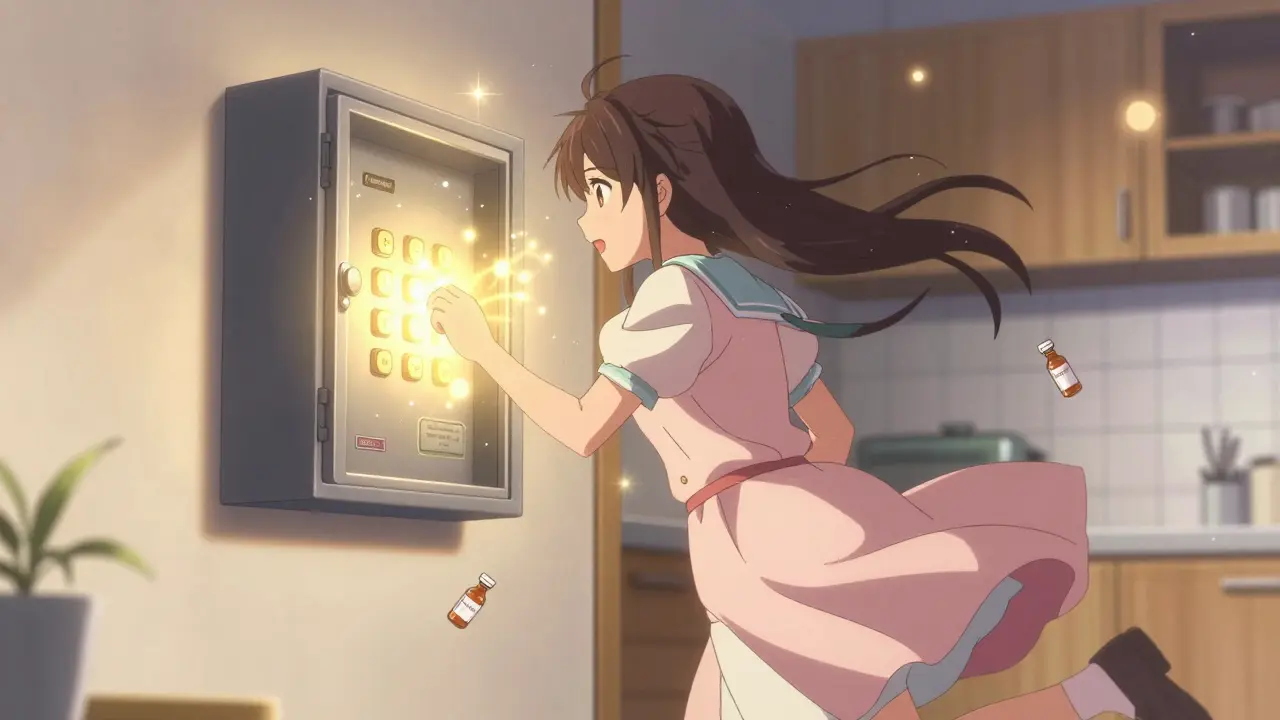
In homes, the goal is simple: keep meds away from children and pets, but within seconds of reach during an emergency. A locked medicine cabinet in the bathroom is a common mistake. If someone is having a heart attack, they won’t have time to find the key or remember the combination. The same goes for storing epinephrine in a locked drawer upstairs while the child is having an allergic reaction downstairs.Instead, use a small, portable lockbox-like a key safe or a medicine safe with a keypad or combination. Keep it in a central location: the kitchen, the main bedroom, or near the front door. These safes are designed to be opened quickly with a code or a key you carry on your person. They’re also tamper-evident: if someone tries to break in, you’ll know.
For households with kids, store the safe at eye level or just above, out of reach of toddlers but accessible to adults. Never store emergency meds in the same place as routine pills. Mixing them creates confusion. Use separate containers. Label the emergency one clearly: "EPIEPEN - EMERGENCY ONLY". A 2023 study showed that households using labeled, separate storage reduced accidental exposure by 68%.
Hospitals and Clinics: The Right Balance
In hospitals, emergency meds are often stored in automated dispensing cabinets (ADCs) with biometric access-fingerprint or ID badge. These systems track who took what, when, and why. They’re great for control. But they can slow things down if not designed right. The Joint Commission found that 17% of medication delays in ERs happened because staff couldn’t get into the cabinet fast enough during a code blue.The fix? Keep the most critical drugs-like epinephrine, atropine, and naloxone-in a separate, wall-mounted emergency cart that’s locked with a tamper-evident seal. These seals break easily with one hand, so in an emergency, you rip it open. Once opened, the cart is flagged for restocking. This is now standard in most U.S. hospitals under The Joint Commission’s MM.03.01.03 standard.
Controlled substances like morphine or fentanyl? They go in a locked, double-locked cabinet-separate from other meds. One lock is electronic (for staff access), the other is a physical key held by pharmacy. This meets DEA requirements and prevents diversion. A 2023 report from the DEA showed 5,223 incidents of controlled substance theft in healthcare settings last year. Most happened because multiple people had access, or the locks weren’t checked daily.
EMS and Ambulances: Mobility Matters
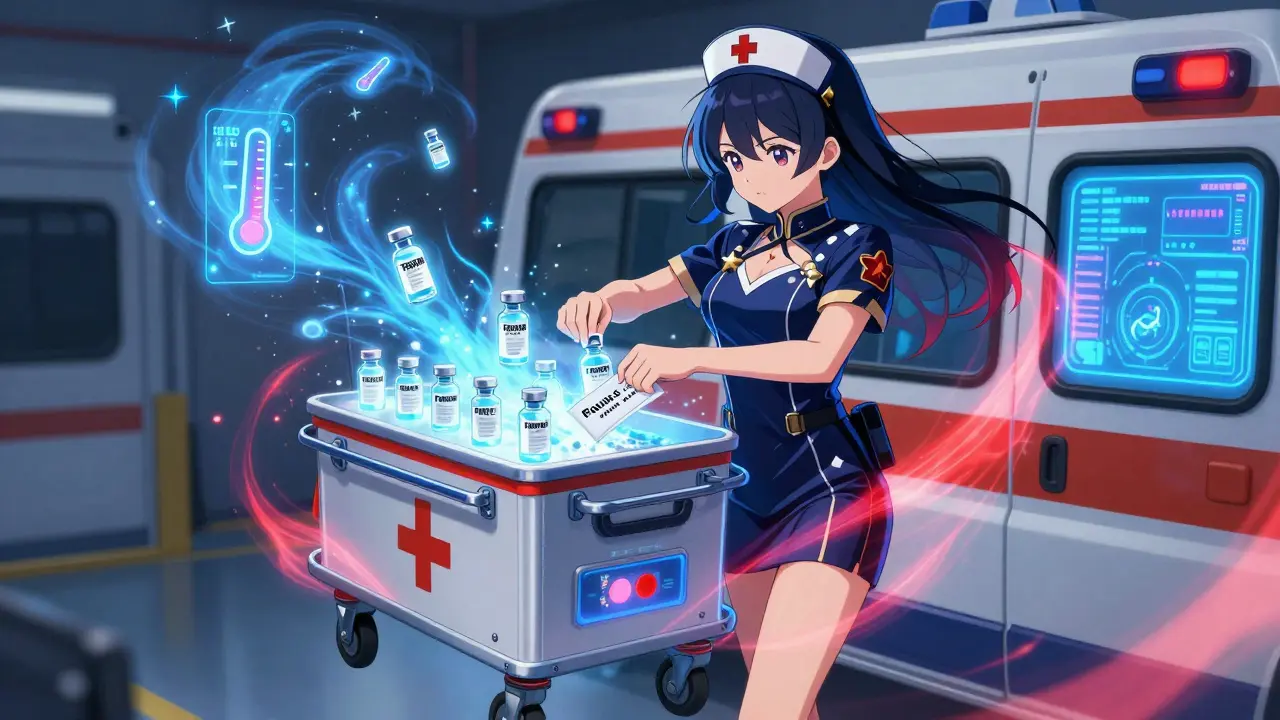
EMS vehicles move. They get hot. They get cold. They get jostled. That’s why temperature control is just as important as physical security. In 2023, 32% of EMS agencies reported that their emergency meds had been exposed to temperatures above 104°F during summer runs. That’s enough to ruin epinephrine or insulin.The solution? Use a lockable, insulated box with a digital thermometer inside. Some models even send alerts to a dispatcher if the temp goes out of range. The box should be bolted to the floor or wall so it doesn’t fly around during a crash. Keys or codes should be with the paramedic on duty-not left in the vehicle. Nevada EMS guidelines (2024) require this. And they’re not alone.
For controlled substances, the box must be double-locked. One lock for the medic, one for the supervisor. No exceptions. A 2022 National EMS Survey found that 17.3% of providers had experienced delays because the box was locked too tightly or the key was missing. That’s unacceptable when someone’s life is on the line.
Childcare and Schools: Easy Access, No Risk
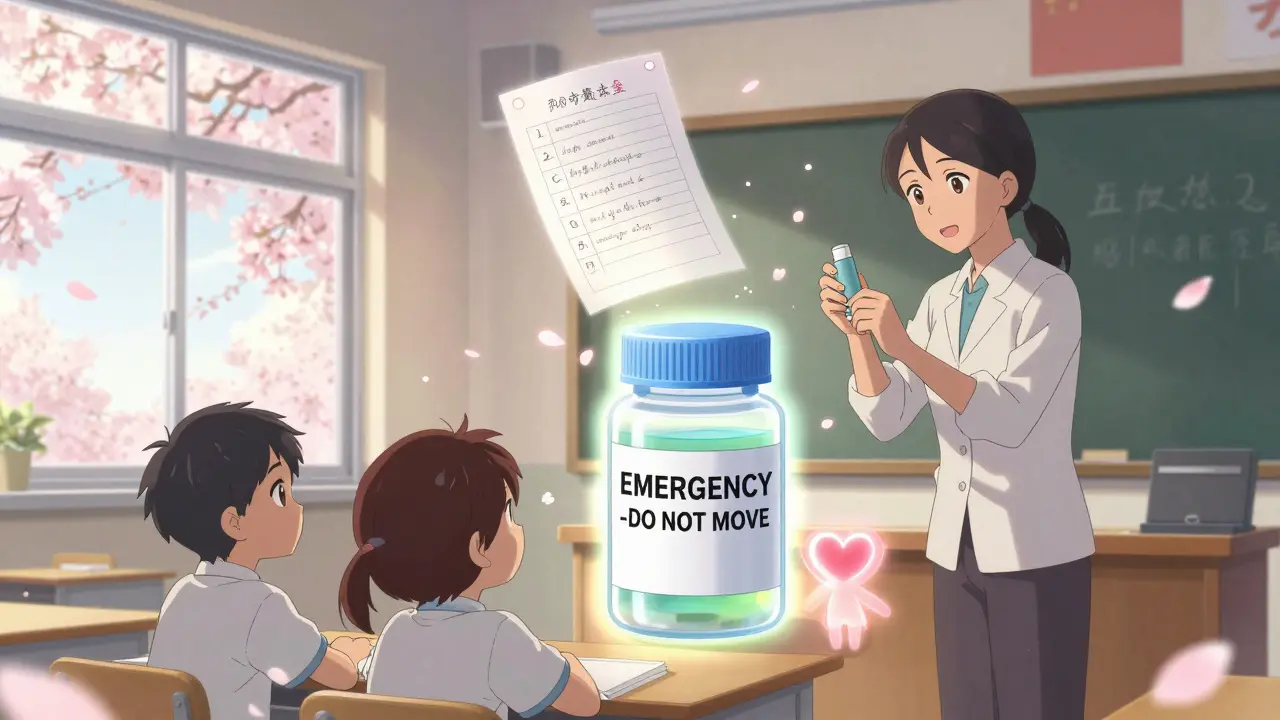
In schools or daycare centers, emergency meds like epinephrine for allergies or albuterol for asthma must be accessible to staff-but not kids. The rules here are clear: no locked cabinets. No keys. No combinations. Instead, use a clearly labeled, unsecured container that’s mounted on the wall at adult height. The container should be sturdy, with a latch that only an adult can open. It’s not about locking it up-it’s about making sure it’s obvious where it is and who’s responsible.Staff must be trained to grab it in under 10 seconds. Drills are required. A 2021 study by Child Health Connection showed that schools with monthly emergency med drills had 80% faster response times during anaphylaxis events. Also, never store meds in a nurse’s office if the office is locked. The child could be having a reaction in the classroom. The med must be where the risk is.
What to Avoid
- Leaving meds on the kitchen counter, bathroom sink, or nightstand-even "just for a minute."
- Storing epinephrine in a car glovebox or trunk.
- Using unlocked drawers or boxes in homes with children or teens.
- Keeping multiple emergency meds in one container without labeling.
- Ignoring expiration dates. Epinephrine loses potency after 18 months. Naloxone lasts longer, but still expires.
What Works
- Portable medicine safes with keypad access for homes.
- Tamper-evident seals on emergency carts in hospitals.
- Insulated, temperature-monitored boxes in ambulances.
- Wall-mounted, unlatched containers in schools.
- Regular training and drills-every 6 months.
Technology is helping too. New FDA-approved devices like TempTraq monitor temperature in real time and alert you if meds are at risk. Smart locks that log access and send notifications to a phone are becoming common in clinics. But the most powerful tool is still simple: knowing where your meds are and practicing how to get to them fast.
Checklist: Your Emergency Meds Security Plan
- Identify each emergency med and its storage needs (refrigerated? room temp? controlled substance?).
- Label every container clearly: "EMERGENCY - DO NOT MOVE".
- Store in a location that’s accessible within 10 seconds during a crisis.
- Use a lock only if it can be opened without a key or code in an emergency (tamper-evident seal, keypad, or pull-tab).
- Keep it away from heat, light, and moisture.
- Check expiration dates every 3 months.
- Train everyone who might need it-family, staff, caregivers.
- Do a 10-second drill once a month.
What’s Changing in 2026
The CDC is updating its home storage guidelines this year, specifically for naloxone and epinephrine. They’re pushing for a new standard: "Lock it, but make it easy." More states are requiring schools to have naloxone on-site-and trained staff to use it. The FDA is also pushing manufacturers to include QR codes on labels that link to storage videos. And AI-powered storage systems? They’re coming. By 2027, smart cabinets will adjust access based on who’s trying to open them, what time it is, and even whether the patient is nearby. But for now, the best system is still the one you know how to use.Can I store emergency meds in the fridge?
Only if the label says so. Epinephrine auto-injectors and some insulin formulations require refrigeration. But most emergency meds, like naloxone or nitroglycerin, are stable at room temperature. Putting them in the fridge can cause condensation, which damages the medication. Always check the manufacturer’s instructions.
What if I’m not sure whether a med is a controlled substance?
Look for the symbol "C-II," "C-III," or similar on the prescription label. These indicate DEA-controlled substances. If you’re unsure, ask your pharmacist. Controlled substances include opioids, benzodiazepines, and certain stimulants. They must be stored in a locked, substantially constructed cabinet separate from other meds.
Is a locked drawer enough for home storage?
No. A drawer can be opened with a butter knife or a credit card. Use a dedicated medicine safe with a keypad, combination, or key that you carry with you. A simple lockbox from a hardware store works too-as long as it’s sturdy and you can open it quickly in an emergency.
How often should I check my emergency meds?
Every three months. Check expiration dates, physical condition (discoloration, cloudiness, leaks), and storage temperature. Replace anything expired or damaged. Set a calendar reminder. A 2023 study found that households that checked meds quarterly had 76% fewer incidents of ineffective emergency treatment.
Can I leave emergency meds in my car?
Never. Cars get extremely hot in summer-over 120°F in the shade. That destroys most medications. Even in winter, cold temperatures can freeze liquids and damage injectables. Always bring emergency meds inside with you.
Kenneth Jones
March 23, 2026 AT 04:28Stop overcomplicating this. Lockbox on the counter. Code you know by heart. No keys. No delays. If your kid gets into it, they’re not dead yet. If you fumble for a key during a cardiac arrest, you’re the problem.
Grace Kusta Nasralla
March 24, 2026 AT 18:40It’s funny how we treat life-saving drugs like they’re secrets to be guarded… as if the real crisis isn’t the fact that we need them at all. We’re so busy securing the container we forget to ask why the body keeps breaking.
Korn Deno
March 25, 2026 AT 10:03Look, the real innovation isn’t the lockbox or the QR code-it’s the culture shift. We treat emergency meds like they’re nuclear codes instead of tools. It’s not about security, it’s about trust. Train people. Teach them. Let them know where it is. A system that requires a code when seconds count is a system designed to fail. The tech is cool, but the human behavior is what saves lives.
My sister’s school has a wall-mounted box labeled ‘EPINEPHRINE - GRAB AND GO’. No locks. No keys. Just a sign and a drill every month. No one’s stolen it. No kid’s opened it. Because they know it’s not a toy. It’s a lifeline.
Aaron Sims
March 26, 2026 AT 02:41Stephen Alabi
March 27, 2026 AT 15:20While the article presents a pragmatic framework, it fundamentally misunderstands the regulatory architecture underpinning controlled substance management. The DEA’s requirement for ‘substantially constructed’ cabinets is not arbitrary-it is codified under 21 CFR § 1301.76(b), and noncompliance constitutes a Class I violation. Furthermore, the assertion that ‘a simple lockbox from a hardware store works’ is not merely inaccurate-it is legally perilous. One must consult state-specific pharmacy board guidelines, which in jurisdictions such as California (Board of Pharmacy Regulation 1718) mandate dual-lock systems even for home storage of Schedule II substances. The conflation of accessibility with lax security is not just irresponsible-it is negligent.
Agbogla Bischof
March 29, 2026 AT 04:19As a pharmacist in Lagos, I can tell you: in places without reliable electricity or locked cabinets, people use sealed plastic containers inside clay pots. Why? Because clay keeps things cool. No tech. No codes. Just smart adaptation. The same logic applies here. Don’t over-engineer. Use what works. A locked box in a hot garage is worse than no box at all. Temperature matters more than locks. Always check the label. Always.
Pat Fur
March 30, 2026 AT 08:22I keep my EpiPen in a little pouch taped to my wallet. No lock. No code. Just me. If I’m having a reaction, I’m not digging through drawers. If my kid needs it, they grab my wallet. Simple. And it’s worked for five years.
Anil Arekar
March 31, 2026 AT 19:35It is imperative to recognize that emergency medication accessibility must be harmonized with cultural norms and familial structures. In many households, particularly in South Asia, the primary caregiver is not always the parent but the grandmother or eldest sibling. Training protocols must account for this reality. A system designed for nuclear families may fail in multigenerational homes. Furthermore, labeling should be multilingual where necessary. A child who cannot read English may still be able to recognize a red symbol or a pictogram. Universal design principles should be applied, not just technical ones.
Additionally, the notion of a ‘10-second drill’ assumes cognitive stability during crisis. In reality, panic induces tunnel vision. Repeated, low-stakes practice-such as incorporating the retrieval into morning routines-is far more effective than emergency drills. This is not merely about access-it is about ingrained habit.
Elaine Parra
March 31, 2026 AT 22:26Let’s be real-this whole ‘lock it but not too tight’ nonsense is just liberal guilt dressed up as safety. You don’t want kids to get into meds? Then teach them not to touch things that aren’t theirs. Don’t reward ignorance with fancy boxes. My 8-year-old knows the difference between candy and medicine because I told her. Not because I bought a $120 keypad safe. And if a thief wants your meds, let them have ‘em. Maybe they’ll need it. Maybe they’ll learn. Maybe the system isn’t broken-maybe you are.
Natasha Rodríguez Lara
April 1, 2026 AT 15:32I’ve been a paramedic for 14 years. I’ve seen every version of this. The best system? A locked box on the wall next to the front door-with a bright red sign and a key taped under the mat. No, really. It’s the one thing we all agree on in the field. You don’t need a code. You don’t need a fingerprint. You need one thing: a place everyone knows. And a backup key. Always have a backup key.
Also, never store epinephrine next to the coffee maker. I’ve pulled two out of melted plastic. One was expired. The other was useless. Check the temp. Check the color. Check the date. Then check again.