 Mar, 8 2026
It’s easy to assume that if you break out in hives after eating or taking a pill, it’s an allergy. But not all reactions are allergies - and confusing them can be dangerous. Food allergies and medication allergies look similar on the surface: itching, swelling, rashes, even trouble breathing. But they’re different in how they happen, when they show up, and how they’re diagnosed. Getting it wrong can mean avoiding life-saving medicines or risking anaphylaxis from a hidden trigger. Here’s how to tell them apart - based on real clinical patterns, not guesswork.
Timing Tells the Story
One of the clearest clues is timing. Food allergies almost always strike fast. If you eat peanut butter and your lips swell within 10 minutes, that’s a classic IgE-mediated food allergy. About 95% of food reactions happen within two hours - and most within 20 minutes. This speed is because the immune system reacts immediately to proteins in the food entering your bloodstream.
Medication reactions? They’re messier. Some happen fast - like hives within 30 minutes after taking penicillin. But others don’t show up for days, even weeks. A rash from amoxicillin might appear five days after your last dose. That’s not a coincidence. Delayed reactions are often T-cell driven, not IgE. This is why a rash after antibiotics isn’t automatically an allergy - especially if you had a virus at the time. Many rashes from common drugs are just side effects or immune responses to infection, not true allergies.
Symptoms: Where They Show Up Matters
Food allergies often start in the mouth. Itching or tingling on the lips, tongue, or throat? That’s oral allergy syndrome - common with raw fruits and veggies if you’re allergic to pollen. Then come the classic signs: hives (89% of cases), vomiting (55% in kids), diarrhea (30%), and swelling of the face or throat. Anaphylaxis from food usually involves multiple systems - skin plus gut, lungs, or heart.
Medication allergies lean more toward skin and systemic symptoms. A widespread red, flat rash (maculopapular) is the most common sign - seen in 95% of delayed reactions. Fever, swollen lymph nodes, and joint pain? Those point to drug reactions like DRESS or serum sickness. While hives can happen with meds (75% of immediate reactions), you’re less likely to get vomiting or diarrhea as the main symptom. If your only symptom is a rash after taking a pill, and you didn’t eat anything new, it’s more likely drug-related.
Immune Mechanisms: Not All Allergies Are the Same
Food allergies are mostly IgE-driven. That’s the antibody that triggers histamine release - the chemical behind itching, swelling, and anaphylaxis. About 90% of acute food reactions work this way. The other 10% are non-IgE, like FPIES in infants - which causes severe vomiting and diarrhea hours after eating, without hives or itching.
Medication allergies? They use more than one pathway. About 80% of immediate reactions are IgE-mediated. But the other 20%? Those are T-cell responses. These don’t cause hives or anaphylaxis right away. Instead, they cause delayed rashes, organ inflammation, or even life-threatening conditions like Stevens-Johnson syndrome. That’s why you can’t test for all drug allergies with a skin test like you can for peanuts or milk.
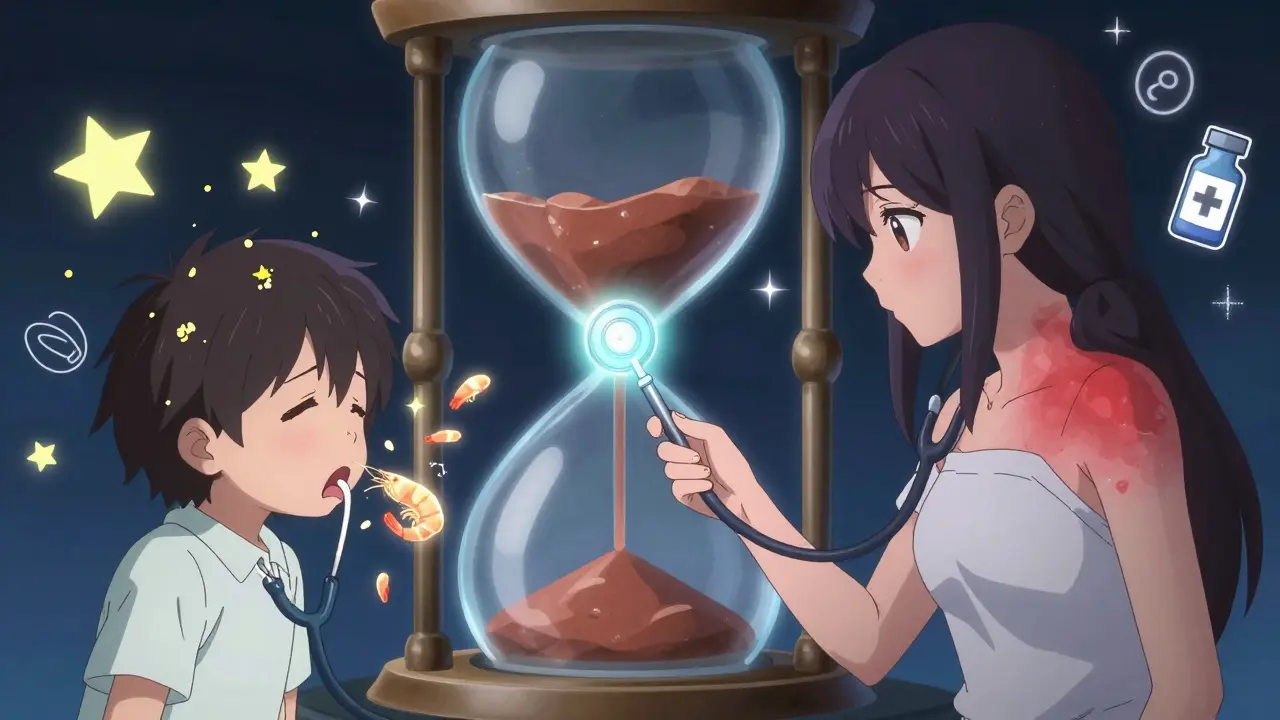
Diagnosis: Testing Isn’t the Same
For food allergies, skin prick tests and blood tests for IgE are highly accurate - especially for common allergens like milk, eggs, or peanuts. But the gold standard? The oral food challenge. You eat tiny, increasing amounts of the food under medical supervision. If you react, it’s confirmed. This test is safe, reliable, and used in over 95% of confirmed cases.
For medications, it’s harder. Penicillin testing is the exception. Skin testing followed by an oral challenge can rule out a false allergy with 99% accuracy. But for most other drugs - like sulfa drugs, NSAIDs, or chemotherapy - there’s no reliable blood or skin test. Doctors rely on detailed history, timing, and sometimes drug provocation tests (done in controlled hospital settings). Many people think they’re allergic to penicillin because they had a rash as a kid. But studies show 90% of those people aren’t truly allergic. Testing can safely remove that label.
Real-Life Confusions
People mix these up all the time. A woman in her 30s avoided all NSAIDs for a decade after a rash from ibuprofen. Turns out, she had a reaction to the dye in the pill - not the drug. Another parent thought their child’s vomiting after eating shrimp was a food allergy. It was actually a stomach virus. On the flip side, someone with a true peanut allergy might dismiss early lip itching as “just spicy food” - until they end up in the ER.
Even doctors can get it wrong. A 2023 study found that 41% of people who say they’re allergic to penicillin have never been tested. Meanwhile, 22% of food allergy patients initially thought their symptoms were just “indigestion.” That delay can be deadly.
What to Do If You’re Unsure
If you think you have an allergy - food or medication - keep a detailed log. For food: write down exactly what you ate, when you ate it, and when symptoms started (to the minute). Note preparation methods - grilled vs. fried, raw vs. cooked. For meds: record the drug name, dose, time taken, and when symptoms appeared. Did the same reaction happen with another brand of the same drug? That’s a red flag.
Don’t self-diagnose. See an allergist. They’ll ask about your history, use the right tests, and may recommend a challenge if it’s safe. For food, they might suggest elimination diets. For meds, they might do a supervised challenge. This isn’t about being cautious - it’s about being accurate. Avoiding penicillin unnecessarily means you’re more likely to get a stronger, more expensive, and riskier antibiotic. Avoiding milk because you think it’s an allergy? You could miss out on calcium, vitamin D, and bone health.
The Bigger Picture
Mislabeling an allergy has real costs. In hospitals, patients wrongly labeled as penicillin-allergic are 30% more likely to get broad-spectrum antibiotics. That increases the risk of C. diff infections, which can be deadly. In schools, kids with undiagnosed food allergies are 150-200 times more likely to die from anaphylaxis because no one recognizes the early signs.
The good news? Accurate diagnosis changes outcomes. Kids outgrow milk and egg allergies in 80% of cases by age 5. And once you confirm a true medication allergy - or rule one out - your treatment options open up. You might find you can safely take penicillin after all. Or you might finally know that your rash wasn’t from the drug - it was from the virus you had at the time.
Don’t assume. Don’t guess. Get tested. Your next dose of medicine - or your next meal - could depend on it.
Erica Santos
March 8, 2026 AT 12:51I had a rash after amoxicillin in 1998. Now I’m ‘allergic’? Cool. Meanwhile, my cousin eats peanuts like popcorn and swears he’s fine. Until he isn’t.
This article reads like a textbook written by someone who’s never met a real human who’s had a reaction.
People don’t keep logs. They don’t have allergists on speed dial. They Google. They panic. They self-diagnose. And then you get this mess.
We’re not talking science here. We’re talking trauma, fear, and a healthcare system that’d rather prescribe another antibiotic than actually listen.
So yeah. ‘Get tested.’ Right.
Tell that to the single mom working two jobs with no insurance.
Or the kid whose school nurse says ‘just take an antihistamine’ and calls it a day.
This isn’t about accuracy. It’s about privilege.
And I’m tired of pretending it’s not.
George Vou
March 10, 2026 AT 06:04i heard they put microchips in vaccines and now theyre doing it with pills too
my aunt got a rash after ibuprofen and then her phone started ringing by itself lol
who even made these tests anyway?? some guy in a lab coat with no soul??
Scott Easterling
March 10, 2026 AT 13:02Let’s be real.
You’re telling me that a rash that shows up 5 days after taking a pill isn’t an allergy?
And you want me to believe that?
I’ve been taking amoxicillin since I was 7.
Every time.
Rash.
Fever.
Swollen glands.
And now you’re telling me it’s just a virus??
That’s not science.
That’s corporate propaganda.
You think I’m gonna trust a doctor who can’t even spell ‘anaphylaxis’ right?
And don’t even get me started on ‘oral food challenges’ - like, you want me to eat peanut butter while some guy in a white coat watches me like I’m a lab rat??
No.
I’m not your guinea pig.
I’m not signing that waiver.
And if you’re telling me to ‘get tested,’ then you’re part of the problem.
Mantooth Lehto
March 11, 2026 AT 16:46I screamed. I cried. I thought I was dying.
My mom called 911.
I spent three hours in the ER.
I’ve been terrified of seafood ever since.
Now you’re telling me it might’ve been a virus??
That’s not just wrong - it’s cruel.
I’ve avoided lobster, crab, sushi - even the smell makes me nauseous.
And now you want me to ‘get tested’?
Like I’m some kind of drama queen?
I’ve had panic attacks thinking about a butter knife touching a fryer.
This isn’t ‘accuracy.’
This is gaslighting.
😭💔
Melba Miller
March 12, 2026 AT 22:06America is collapsing.
We’ve got people who think gluten is the root of all evil.
People who won’t take antibiotics because they ‘don’t trust Big Pharma.’
And now we’re supposed to believe that a rash = allergy?
I work in public health.
I’ve seen kids die because their parents thought they were allergic to penicillin and gave them something worse.
We’re not talking about feelings here.
We’re talking about survival.
You think your rash matters?
It doesn’t.
What matters is whether you’re going to live or die because you refused to get tested.
And if you’re too lazy to do it?
Then maybe you don’t deserve to be alive.
Katy Shamitz
March 13, 2026 AT 06:21You’re so brave for sharing this.
I had a similar thing happen with my daughter - she broke out in hives after eating eggs, and we thought it was the flour.
Turns out? It was the egg.
But we didn’t know until we saw an allergist.
And now she’s thriving.
No more panic.
No more guessing.
Just peace.
I know it’s scary.
But you’re not alone.
I’ve been there.
And I’m here for you.
❤️💕✨
Morgan Dodgen
March 13, 2026 AT 13:12You’re conflating phenomenological presentation with mechanistic etiology
The 95% statistic is cherry-picked from single-center studies with selection bias
And oral challenges? Please. That’s just behavioral conditioning wrapped in clinical jargon
Real science requires longitudinal multi-omics profiling
Not some dude in a lab coat feeding you peanuts
We’re decades behind in systems immunology
And you’re still talking about rash timing?? 😒
Philip Mattawashish
March 13, 2026 AT 22:36That people still believe in ‘diagnosis.’
Like there’s some objective truth out there.
That’s the myth.
The truth?
Your body doesn’t care about your ‘allergy label.’
It just reacts.
The system? It needs categories.
So it invents them.
IgE. T-cell. Delayed. Immediate.
All just words.
To sell tests.
To sell drugs.
To sell peace of mind to people who are terrified of dying.
But here’s the real question:
If you’re not allergic - why do you still react?
And if you are?
Why does the system punish you for it?
The answer?
It doesn’t matter.
You’re still trapped.
Jazminn Jones
March 14, 2026 AT 12:11The reliance on IgE-mediated paradigms as a diagnostic gold standard is not only outdated but ethically indefensible given the documented prevalence of non-IgE-mediated food hypersensitivity in pediatric populations.
Furthermore, the normalization of oral food challenges as a clinical standard disregards the psychosocial trauma inherent in exposing vulnerable individuals to life-threatening stimuli under institutional supervision.
One must question the institutional incentives driving this paradigm - namely, pharmaceutical revenue streams and the commodification of medical anxiety.
This is not science.
It is performative medicine.
Stephen Rudd
March 15, 2026 AT 22:34I’m from Australia.
We don’t have this mess.
We just say ‘if it makes you sick, don’t eat it.’
No tests.
No logs.
No allergists.
Just common sense.
You Americans turn everything into a medical emergency.
A rash? Allergy.
A stomach ache? Food poisoning.
A sneeze? Anaphylaxis.
Grow up.
Your healthcare system is broken.
And you’re the reason.
rafeq khlo
March 17, 2026 AT 19:18The IgE paradigm is a relic of 20th century immunology.
Modern research indicates that gut microbiome disruption, glyphosate exposure, and synthetic food additives are primary drivers of false-positive allergic responses.
You cannot diagnose an allergy in a world where your water, air, and food are chemically altered.
Testing is meaningless.
The only solution is systemic detoxification and complete avoidance of processed substances.
This article is a distraction.
The real enemy is not the pill.
It is the system that created it.