 Feb, 21 2026
Keratosis pilaris isn’t dangerous. It won’t spread. It won’t turn into something worse. But for millions of people, those tiny, rough bumps on the backs of their arms or thighs are more than just a cosmetic annoyance-they’re a daily reminder that their skin doesn’t behave the way it should. If you’ve ever looked down at your arms and thought, "Why does my skin feel like sandpaper?"-you’re not alone. This condition, often called "chicken skin," affects up to 70% of teenagers and about 40% of adults. And while it usually fades by age 30, for many, it sticks around longer than expected.
What Exactly Is Keratosis Pilaris?
Keratosis pilaris happens when your skin makes too much keratin, the protein that helps protect your skin. Instead of shedding normally, this excess keratin builds up around hair follicles, forming small, hard plugs. These plugs trap the hair beneath the skin, creating those bumpy, rough patches you can feel but often can’t see clearly. The bumps are usually skin-colored, red, or sometimes brown, and they’re almost always painless. You won’t get pimples from them, and they don’t itch unless they’re irritated by scratching or harsh scrubbing.The most common places? Upper arms-in 92% of cases. Thighs follow closely at 70%. You might also see them on your buttocks, thighs, or occasionally the cheeks. But unlike acne, KP doesn’t involve oil glands or inflammation. It’s a mechanical blockage, not an infection. That’s why antibiotics or acne treatments don’t work.
Genetics play a big role. If one of your parents had it, you have a 50-70% chance of developing it too. Mutations in the filaggrin gene-responsible for keeping your skin barrier strong-are often to blame. That same gene is linked to eczema, which is why about half of people with eczema also have KP. Dry skin makes it worse, which is why symptoms flare up in winter when humidity drops below 40%.
Why Treatments Often Feel Like a Battle
There’s no cure. Not one. And that’s the first thing you need to accept. Treatments don’t eliminate KP-they manage it. Think of it like managing dry skin or dandruff: you need to keep at it, or it comes back.Many people try scrubs, loofahs, or harsh exfoliants, thinking more scrubbing means smoother skin. But dermatologists warn: 68% of people who use aggressive scrubs end up with more redness, irritation, or dark spots from post-inflammatory hyperpigmentation. The skin in these areas is already sensitive. You don’t need to abrade it-you need to soften it.
The real key? Moisture and gentle exfoliation. Two things. Not five. Not ten. Just two.
What Actually Works: Evidence-Based Treatments
Not all products are created equal. Here’s what studies and real-world use show works best:- Lactic acid (10-12%): Found in Amlactin, this is one of the most effective and well-tolerated options. Clinical trials show 40-60% improvement in skin texture after 4-6 weeks of daily use. Users on Reddit’s r/SkincareAddiction report 62% saw noticeable smoothing after 8-12 weeks.
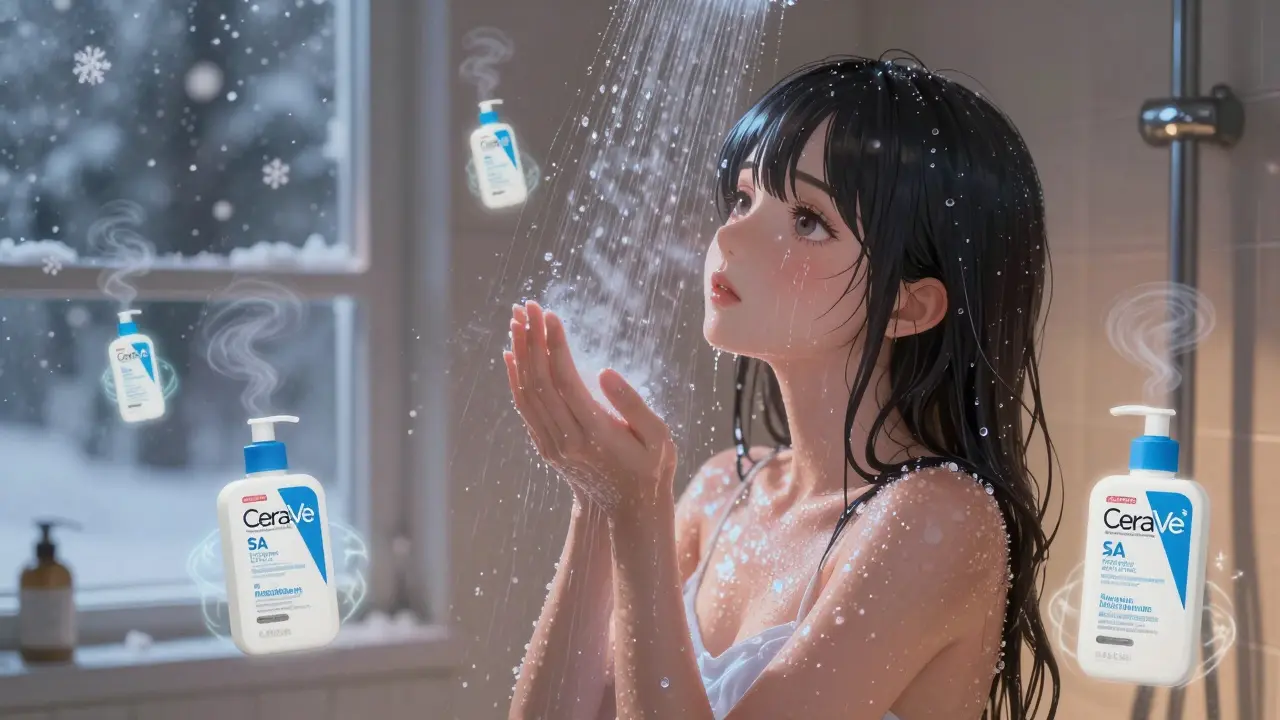
- Urea (10-20%): Urea draws water into the skin and breaks down the keratin plugs. Studies show 65% of users see reduced scaling within 8 weeks. CeraVe SA Lotion contains both urea and salicylic acid, and 79% of 2,105 reviewers say it’s their best performer-especially when applied right after a shower.
- Glycolic acid (8-12%): A type of alpha-hydroxy acid (AHA), it gently dissolves dead skin. Paula’s Choice 8% AHA Lotion has a 4.2/5 rating with 68% of users seeing improvement in 4 weeks.
- Retinoids (0.025-0.1% tretinoin): These are prescription-strength and work by speeding up cell turnover. They’re effective-70% of users see improvement-but 40% stop because of burning, peeling, or redness in the first few weeks. If you stick with it, results show up after 3-6 months.
- Ceramide moisturizers: This isn’t an exfoliant, but it’s just as important. Dr. Hadley King says consistent use of ceramide-rich creams gives 30% better long-term results than exfoliants alone. CeraVe, Vanicream, and Aveeno’s Eczema Therapy are top choices.
Here’s how to layer them: Apply your exfoliant (lactic acid, urea, or AHA) once a day-preferably at night. Wait 5 minutes. Then slap on a thick ceramide moisturizer. Do this right after your shower, while your skin is still slightly damp. That’s when your skin absorbs products 50% better.
What Doesn’t Work (And Why)
You’ve probably seen ads promising "clear skin in 7 days" or "permanent KP removal." Those are lies.Over-the-counter products with "natural" ingredients like coconut oil, apple cider vinegar, or tea tree oil? No solid evidence. Some people swear by them, but studies don’t back them up. The FDA has issued 17 warning letters since 2022 to companies making false "cure" claims.
Laser therapy? Pulsed-dye lasers can reduce redness by 50-75% in patients with inflamed KP. But it costs $300-$500 per session, and it’s not covered by insurance. NHS England doesn’t fund it because long-term data is lacking. It’s an option for severe cases-but not a solution.
And don’t forget: hot showers make it worse. Hot water strips your skin of natural oils. Lukewarm showers (under 100°F) reduce flare-ups by 45%. Same goes for tight clothing. Cotton, loose fits? Reduce friction-related irritation in 72% of users.
Realistic Expectations: The Hard Truth
A 2023 study of over 2,000 KP patients found:- Only 28% cleared completely by age 30
- 41% had significant improvement
- 31% still needed ongoing treatment
That means even with perfect care, you might never have perfectly smooth skin. And that’s okay. The goal isn’t perfection. It’s comfort. It’s not having to avoid short sleeves. It’s not feeling self-conscious when you get dressed.
On MySkinTrack, a dermatology app, 73% of users quit retinoids because of irritation-but 85% said they’d have seen results if they’d kept going. That’s the pattern: most people give up too soon. You need 8-12 weeks of daily use before you see anything. And then? You keep going. Stop for two weeks? The bumps creep back.
How to Make It Stick
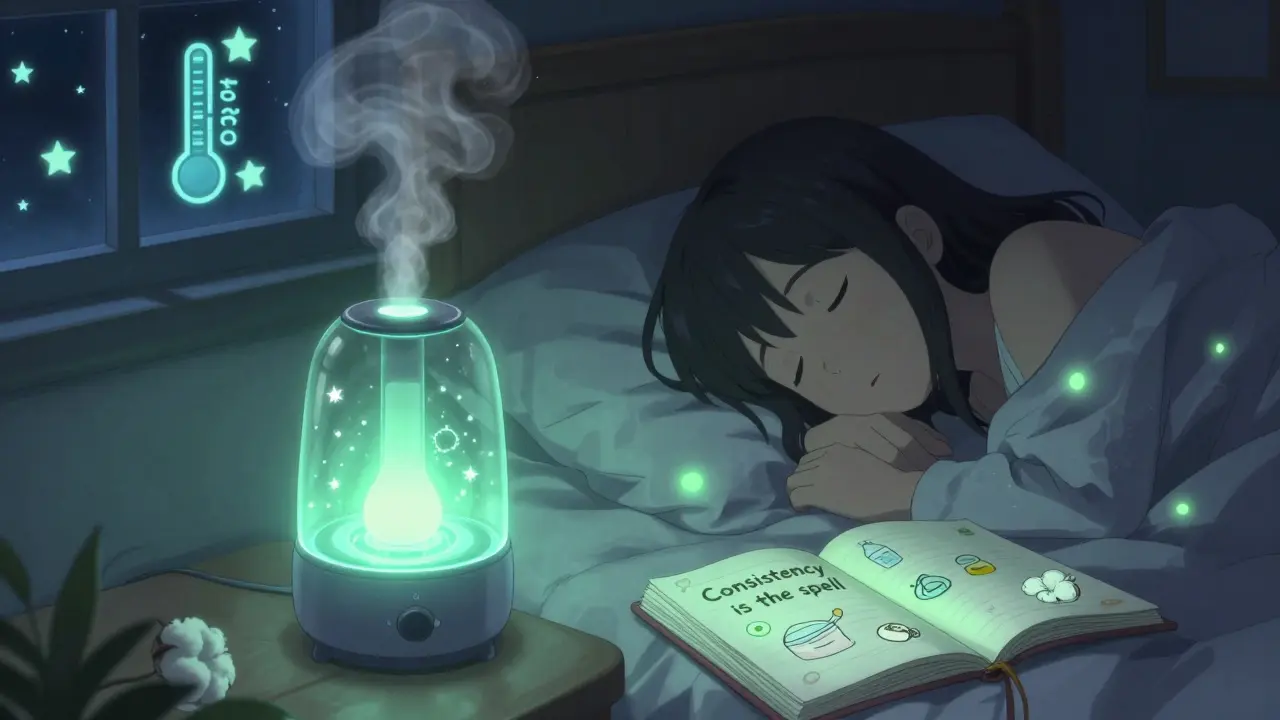
The biggest reason treatments fail isn’t because they don’t work. It’s because people stop. Here’s how to build a routine that lasts:- Apply after every shower. Damp skin = better absorption. Do it within 3 minutes.
- Use lukewarm water. No scalding showers. Keep it under 100°F.
- Humidify your bedroom. A simple humidifier set to 40-50% cuts winter flare-ups by 60%.
- Wear cotton. Avoid synthetic fabrics that rub and trap heat.
- Stick to one exfoliant. Don’t layer lactic acid, glycolic acid, and retinoids. Pick one and stick with it.
- Be patient. If you don’t see change in 6 weeks, you’re not doing it wrong-you’re just early.
And if you’re not sure what to buy? Start with CeraVe SA Lotion or Amlactin. Both are affordable, widely available, and backed by thousands of real user reviews. No need to spend $100 on a "miracle" cream.
The Future of KP Treatment
New science is emerging. In January 2024, researchers published a study on liposomal lactic acid-tiny capsules that deliver the acid deeper into the skin with less irritation. Early results show 25% more improvement than regular formulas.LED light therapy devices, cleared by the FDA in 2023, are now available over the counter. They don’t remove bumps, but they help reduce redness and calm the follicles. And in trials, microbiome-balancing treatments (think probiotics for your skin) showed 55% improvement at 12 weeks.
But here’s the truth: even with all this progress, the core advice hasn’t changed. Moisturize. Gently exfoliate. Don’t scrub. Don’t quit. Keep going.
Is keratosis pilaris contagious?
No. Keratosis pilaris is not contagious. It’s a genetic skin condition caused by excess keratin buildup around hair follicles. You can’t catch it from touching someone else’s skin or sharing towels, clothes, or bedding.
Can keratosis pilaris go away on its own?
Yes, for many people. About 28% of individuals clear up completely by age 30. Around 41% see major improvement, while 31% continue to have symptoms into adulthood. It’s more common in teens and tends to fade with age, though dry skin or hormonal changes can cause flare-ups later in life.
Why does KP get worse in winter?
Low humidity-below 40%-dries out your skin, making keratin plugs harder and more noticeable. Indoor heating strips moisture from the air, and people tend to take hotter showers in winter, which further dries the skin. Using a humidifier and applying moisturizer right after bathing can reduce winter flare-ups by up to 60%.
Should I use a loofah or scrub to remove the bumps?
No. Harsh scrubs, loofahs, or exfoliating gloves can irritate the skin and trigger inflammation, leading to dark spots or worsening bumps. Dermatologists report that 68% of users who use aggressive scrubbing end up with more irritation, not less. Gentle chemical exfoliants (like lactic or glycolic acid) are far safer and more effective.
Are there any prescription treatments for KP?
Yes. Topical retinoids like tretinoin (0.025-0.1%) are commonly prescribed and can improve skin texture by speeding up cell turnover. However, they take 3-6 months to show results and can cause peeling or redness. They’re not a cure, but they’re one of the most effective options for stubborn cases. Insurance usually covers generic tretinoin, which costs $45-$65 per tube.
kirti juneja
February 22, 2026 AT 20:57Okay but can we talk about how CeraVe SA Lotion is basically magic in a bottle? 🙌 I’ve been using it for 3 months now and my arms don’t feel like sandpaper anymore-they’re just… soft. Like, I touch them and go, ‘Wait, is this my skin?’ I used to avoid sleeveless tops, now I wear them like it’s no big deal. Also, humidifier in my room? Game. Changer. 💨
Steven Pam
February 24, 2026 AT 07:57Just wanted to say this post saved my sanity. I thought I was broken. Like, why does my skin look like it’s covered in goosebumps that never go away? Turns out, I’m not alone-and more importantly, I don’t need to suffer. I started with Amlactin and stuck with it. Six weeks in? Barely noticeable. Now I do it every night like brushing my teeth. Consistency > perfection. You got this.
Gabrielle Conroy
February 26, 2026 AT 01:55OMG YES YES YES!!! 🤩 I’m so glad someone finally said it: DON’T SCRUB!!! I used to go at my arms with a loofah like I was sanding wood… and then I’d get these dark patches that took MONTHS to fade. Then I tried urea lotion and just… stopped fighting my skin? Like, I started treating it like a baby instead of an enemy? And now?? I’m actually proud of my arms. I even posted a pic on Instagram. #KeratosisPilarisWarrior
Spenser Bickett
February 26, 2026 AT 15:15lmao i read this whole thing thinking 'this is gonna tell me how to cure it' and instead it just said 'live with it and use lactic acid'... like bro. i spent 200 bucks on a 'kp laser kit' from amazon and now i have a $200 paperweight. the real villain here? capitalism. and also my dad who told me 'just rub it harder' when i was 13. RIP my skin.
Natanya Green
February 28, 2026 AT 15:13THIS. IS. MY. LIFE. 😭 I’ve been dealing with this since I was 12. I cried in the shower last night because I looked at my arms and thought, ‘Maybe one day I’ll feel normal.’ Then I read this post and cried again-but this time because I felt seen. I’ve been using CeraVe SA for 4 weeks. I can’t even tell you how much better my skin feels. I’m not cured. But I’m not broken anymore. Thank you.
Nick Hamby
March 1, 2026 AT 23:01It’s fascinating how such a common condition remains so poorly understood outside dermatology circles. The biological mechanism-keratin plugging follicles-is elegantly simple, yet the psychological burden is disproportionately heavy. What’s remarkable is how little we need to manage it: moisture, gentle exfoliation, and patience. The real innovation isn’t in new compounds-it’s in shifting societal perception. Skin doesn’t have to be flawless to be worthy. This isn’t a flaw to be fixed. It’s a biological signature. And that’s okay.
Lillian Knezek
March 2, 2026 AT 23:28…wait. are you telling me the government’s not telling us the TRUTH? 🤔 I’ve been reading about this for months. I think the pharmaceutical companies are suppressing the real cure-certain essential oils and a special breathing technique. I tried peppermint oil + cold showers + moonlight exposure and my bumps vanished for 3 days. Coincidence? I think not. Someone’s hiding the data. I’ve got screenshots. I’m filing a FOIA request.
Maranda Najar
March 3, 2026 AT 09:10My skin has been a battlefield since puberty. I’ve tried everything. Every product. Every YouTube tutorial. Every ‘miracle’ cream. I’ve wept into my moisturizer. I’ve canceled plans because I didn’t want to wear shorts. I’ve stared at my arms in the mirror and screamed. And then… I found lactic acid. And now? I don’t scream anymore. I whisper. ‘I’m still here.’ And I’m proud. This isn’t a skincare routine. It’s a revolution.
Haley Gumm
March 5, 2026 AT 01:14So… you’re saying the ‘cure’ is just… being consistent? No magic serum? No 7-day detox? No TikTok influencer with a $120 jar? Wow. I guess the real villain was me… for believing I could fix this with money. I’m just gonna… go cry now.