 Feb, 22 2026
More people are getting prescriptions online than ever before. In 2026, if you need medication for high blood pressure, depression, or even opioid use disorder, you can often get it without stepping into a doctor’s office. But here’s the catch: not all prescriptions are treated the same. Telemedicine prescriptions for generic drugs like sertraline or metformin are simple. But if you’re trying to get a refill for buprenorphine or Adderall? It’s a whole different story.
How Telemedicine Prescriptions Work Today
Let’s say you’re managing anxiety and your doctor has you on generic sertraline. You’ve been stable for a year. You log into your telehealth app, answer a few questions, and within minutes, your prescription is sent to your local pharmacy. No in-person visit. No waiting. It’s fast, convenient, and legal - because sertraline isn’t a controlled substance.
But if you’re on generic buprenorphine - a Schedule III drug used to treat opioid addiction - the rules change dramatically. Under new DEA rules effective January 2025, you can only get an initial six-month supply via telemedicine. After that, you need either an in-person visit or to meet strict criteria to continue remotely. This doesn’t apply to every medication. It only applies to controlled substances. And that’s where things get messy.
Controlled vs. Non-Controlled: The Big Divide
The U.S. government doesn’t treat all prescriptions the same. The DEA divides medications into five schedules based on abuse potential. Schedule II drugs - like generic oxycodone or Adderall - are high-risk. Schedule III-V drugs - like buprenorphine, hydrocodone, or certain stimulants - are lower risk but still regulated.
Here’s the real difference:
- Non-controlled generics (like lisinopril, metformin, sertraline): Can be prescribed via telemedicine with no time limits. No in-person visit needed. No special registration required.
- Controlled generics (like buprenorphine, generic Adderall): Subject to DEA rules. Initial telemedicine prescriptions capped at six months. Must use electronic prescribing (EPCS). Must check state prescription drug monitoring programs (PDMPs) before every prescription. Must verify identity with government-issued ID.
That means if you’re on generic buprenorphine, your doctor can’t just send you a 90-day refill every month. They have to document every step. They have to log into your state’s PDMP system - which, in some states, still doesn’t talk to other states’ systems. And if they mess up? Their prescription gets rejected.
The New DEA Registration System (2025 Rules)
In January 2025, the DEA rolled out three new registration categories for telemedicine prescribing. These aren’t suggestions - they’re requirements. If you’re a provider and you’re prescribing controlled substances remotely, you need one of these:
- Telemedicine Prescribing Registration: For providers treating opioid use disorder. Allows initial six-month supply via telemedicine. Requires EPCS, PDMP checks, and ID verification. Only applies to Schedule III-V drugs.
- Advanced Telemedicine Prescribing Registration: For specialists only - psychiatrists, neurologists, pediatricians, hospice doctors. Lets them prescribe Schedule II-V drugs remotely. Primary care doctors are excluded unless they prove an "extremely compelling" case.
- Telemedicine Platform Registration: For companies like Teladoc, MDLive, or others that connect patients with providers. Must register with DEA, implement identity verification, and keep audit trails.
Here’s what this means in practice: If you’re a family doctor in rural Kansas trying to help a patient with opioid addiction, you can’t prescribe buprenorphine via telemedicine unless you’ve jumped through all these hoops. Most haven’t. Only 31 out of 127 telehealth platforms have completed the full DEA registration as of July 2025.
Why PDMP Checks Are a Nightmare
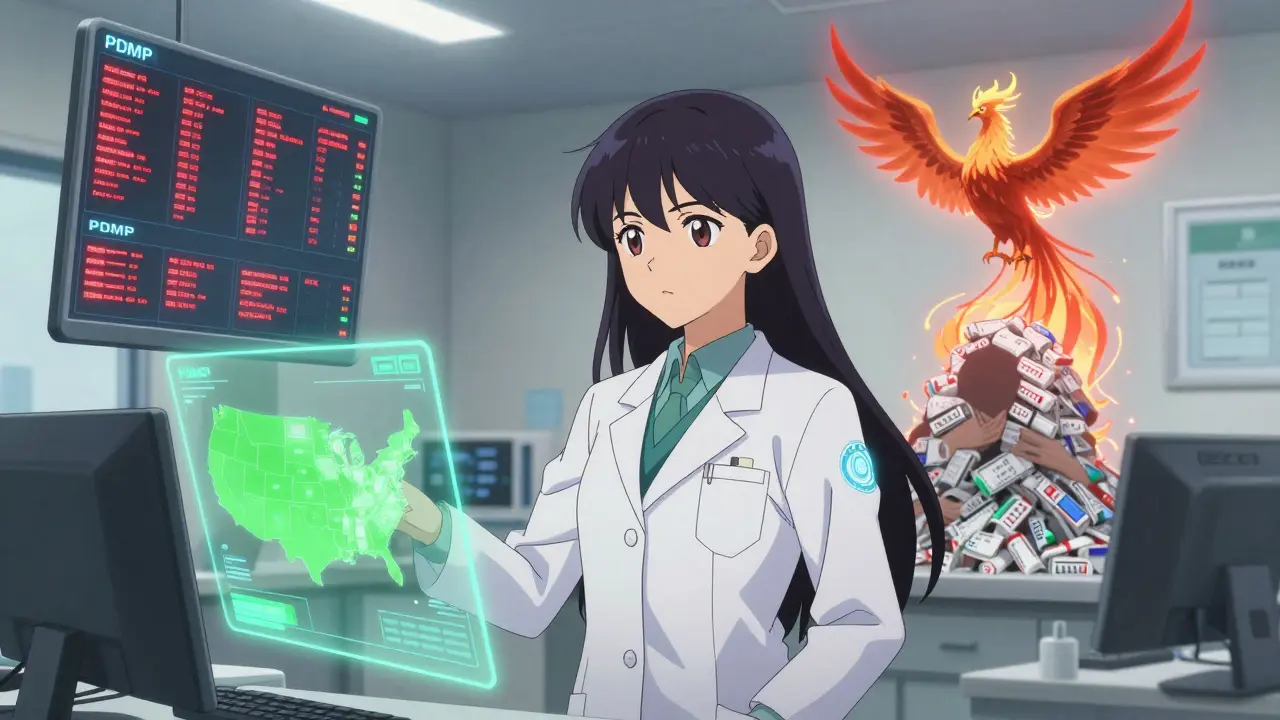
One of the biggest roadblocks? Prescription Drug Monitoring Programs. Every state has one. They track who’s getting what, when. The DEA now requires providers to check the PDMP before every controlled substance prescription.
But here’s the problem: PDMPs don’t talk to each other. If your patient lives in Nevada but you’re licensed in California, you have to log into Nevada’s system, then California’s, then maybe Arizona’s if they’ve traveled. Each system has different passwords, different interfaces, different delays.
Dr. Michael Reynolds, a family physician in Montana, says it adds 15 to 20 minutes to every appointment. “I’m seeing 12 patients a day. That’s three extra hours of paperwork,” he told the American Telemedicine Association in June 2025.
And it’s not just time. The DEA reported that 42% of initial registration applications in Q1 2025 were rejected - mostly because doctors didn’t document PDMP checks correctly. One doctor forgot to timestamp the check. Another didn’t include the patient’s state ID number. These aren’t big mistakes. But they’re enough to get a prescription denied.
Pharmacies Are Confused Too
Even if the doctor gets it right, the pharmacy might not.
“I had three prescriptions rejected this month,” wrote a telepsychiatrist on Reddit in July 2025. “I’m in California prescribing to a patient in Nevada. DEA says it’s allowed. But the pharmacist said, ‘We don’t do out-of-state telemedicine for controlled substances.’”
That’s not an isolated case. Pharmacists aren’t trained on these new rules. Many still think telemedicine for controlled substances is illegal. They’re used to the old Ryan Haight Act - the law that banned all telemedicine prescribing of controlled substances before 2020. Even though that law has been modified, the old mindset lingers.
Pharmacies also don’t always accept digital IDs. If a patient uses a state driver’s license, but the system only recognizes federal IDs? The prescription gets held up. Or worse - denied.

Who’s Getting Left Behind
The new rules sound strict, but they’re meant to protect patients. Still, they’re creating new barriers.
Take addiction treatment. The American Society of Addiction Medicine says 80% of patients with opioid use disorder first go to their primary care doctor. But under the new DEA rules, primary care doctors can’t prescribe buprenorphine via telemedicine unless they qualify for the Advanced Registration - which they almost never do.
That means patients in rural areas - who already struggle to find addiction specialists - now have to drive hours for an in-person visit just to keep their medication. A 2025 survey by the Addiction Policy Forum found 73% of patients said telemedicine improved their access. But those same patients also report delays, denials, and confusion.
And then there’s Medicare. Starting October 1, 2025, Medicare will only reimburse telehealth prescriptions if the patient had an in-person mental health visit in the past. That’s going to cut reimbursement for telemedicine prescriptions by nearly half. It’s not about safety - it’s about bureaucracy.
What You Can Do
If you’re a patient:
- Know your medication’s schedule. Is it controlled? Ask your provider.
- Have your government-issued ID ready - digital or physical.
- Ask if your provider checks PDMPs. If they don’t, they can’t legally prescribe controlled substances.
- If your prescription gets denied, ask why. It might be a pharmacy error, not a rule violation.
If you’re a provider:
- Get DEA-compliant EPCS certification. It’s an 8-hour course. Do it.
- Register with the DEA under the correct category. Don’t guess.
- Integrate your EHR with PDMPs. If your system doesn’t support it, switch.
- Train your staff. Pharmacists, front desk, billing - everyone needs to know the rules.
The Future: What’s Coming in 2026
The current telemedicine flexibilities expire on December 31, 2025. After that, the new DEA rules are permanent. No more extensions.
That means:
- Non-controlled generics will keep growing. They’re easy, safe, and in high demand.
- Controlled substance prescribing will shrink. Platforms will drop services they can’t legally support.
- PDMP integration will improve - slowly. The DEA has allocated $127 million to build a national system, but experts say it won’t be fully functional until late 2027.
By 2026, telemedicine for generics like metformin, lisinopril, or sertraline will be as normal as ordering groceries online. But for controlled substances? It’ll be a patchwork of rules, tech failures, and provider burnout. The system works - if you know how to navigate it.
Can I get a prescription for generic Adderall through telemedicine?
Only if your provider has the Advanced Telemedicine Prescribing Registration - and even then, only if they’re a board-certified psychiatrist, neurologist, pediatrician, or hospice physician. Primary care doctors can’t prescribe it remotely. Generic Adderall is a Schedule II controlled substance, so it’s subject to the strictest rules. Most telehealth platforms don’t offer it.
Why can I get buprenorphine via telemedicine but not oxycodone?
It’s about risk level and policy goals. Buprenorphine (Schedule III) is used specifically to treat opioid addiction, and the government wants to expand access to it. Oxycodone (Schedule II) is seen as higher risk for misuse. So while you can get a six-month supply of generic buprenorphine via telemedicine, oxycodone - even in generic form - is restricted to specialists under very narrow conditions.
Do I need an in-person visit every time I refill my generic blood pressure pill?
No. If your medication is not a controlled substance - like lisinopril, amlodipine, or hydrochlorothiazide - you can get refills via telemedicine indefinitely. No in-person visits required. The DEA doesn’t regulate these drugs the same way. This is why telemedicine for generics is growing so fast.
What happens if my telemedicine prescription gets rejected by the pharmacy?
It’s usually not your fault. Ask the pharmacist why. Common reasons: they didn’t recognize your state’s PDMP check, they thought telemedicine for controlled substances was still illegal, or they couldn’t verify your identity. You can ask your provider to resend it with clearer documentation. If it keeps happening, switch to a pharmacy that’s trained on the new DEA rules.
Can I use telemedicine if I live in a state that bans it?
State laws can override federal rules. Arkansas, for example, still requires an in-person exam before any controlled substance prescription - even if the DEA allows it. If you live in a restrictive state, your provider must follow your state’s law, not the federal one. Always check your state’s medical board website for current telemedicine rules.
Nerina Devi
February 24, 2026 AT 10:22It's wild how something as simple as a prescription can turn into a bureaucratic maze. I have a cousin in rural India who depends on telemedicine for his hypertension meds - lisinopril, no control issues - and he gets it delivered to his village in three days. But if he needed something like buprenorphine? He'd have to travel 200 kilometers just to get a signature. The system isn't broken - it's just designed for people who already have privilege.
Dinesh Dawn
February 24, 2026 AT 11:01Been using telehealth for my anxiety meds since 2022. Sertraline? Easy. Buprenorphine? Not even worth asking. I get why the rules are tight, but the way it’s implemented feels like punishment for people who need help the most. No one’s arguing for lax rules - just for some common sense.
Vanessa Drummond
February 25, 2026 AT 07:47Let me get this straight - you can get a 90-day supply of Adderall if you’re a psychiatrist in New York, but if you’re a family doc in Nebraska trying to help someone with ADHD? Nope. No way. Not even if they’ve been stable for five years. This isn’t regulation - it’s performance art. Someone’s getting paid to make this complicated.
Nick Hamby
February 26, 2026 AT 20:09There is a fundamental tension here between autonomy and oversight. On one hand, we must prevent diversion and abuse - a legitimate public health imperative. On the other, we risk alienating those who rely on telemedicine not out of convenience, but out of necessity - geographic isolation, disability, stigma, or lack of transportation. The current framework attempts to balance these, but in practice, it tilts toward obstruction. The solution is not fewer rules - it is smarter rules, better integration, and a recognition that care is not a binary of safe versus dangerous, but a spectrum of access and dignity.
kirti juneja
February 27, 2026 AT 00:13Oh honey, this whole thing is a hot mess wrapped in a PDF. I work in a clinic where we have to log into 5 different PDMPs just to refill one script. One time, a patient’s prescription got rejected because the pharmacist thought ‘buprenorphine’ was a brand name. I had to send a screenshot of the DEA guidelines. We’re not fighting addiction - we’re fighting paperwork gremlins. And don’t even get me started on the guy who used his Walmart photo ID and got denied because ‘federal ID only.’ Like, bruh, I’m from Texas - we all use our driver’s license for everything.
Haley Gumm
February 28, 2026 AT 21:49Let’s be real - this isn’t about patient safety. It’s about liability. Providers are scared. Pharmacies are scared. The DEA is scared. So they create rules so complex, so brittle, that no one dares to break them - even when it hurts patients. The people who need help the most? They’re the ones getting caught in the cracks. And no one’s apologizing. Just shrugging and saying, ‘It’s the law.’
Gabrielle Conroy
March 1, 2026 AT 10:19YES! I’m so glad this was written! 🙌 I’ve been trying to get my ADHD med refilled via telehealth since January, and I’ve had THREE prescriptions rejected - not because I did anything wrong, but because the pharmacy’s system didn’t recognize my state’s PDMP output! 😤 I finally found a pharmacy in my city that’s DEA-compliant and trained - they even sent me a PDF of their policy! 📄✨ If you’re struggling, don’t give up - just switch pharmacies. And tell your provider to call them directly - it helps! 💬❤️
Spenser Bickett
March 1, 2026 AT 11:54so like… if you’re on adderall and you’re not a neurologist or a pediatrician or some fancy schmancy doc… you’re just SOL? wow. what a surprise. the system is designed to make sure only rich people get meds. the rest of us? we gotta drive 3 hours to a clinic that probably doesn’t even take medicaid. and the DEA? they’re out here writing 300-page manuals while people are dying from withdrawal. cool. very cool. #freedom