 May, 21 2026
Your eyes feel gritty. They burn when you look at bright lights. Maybe they even look like they’re bulging out of your sockets. If you have Graves' disease, a common cause of hyperthyroidism, this isn't just dry eye syndrome. It could be Thyroid Eye Disease (TED), an autoimmune condition that attacks the tissues behind your eyes. Also known as Graves' ophthalmopathy or thyroid-associated orbitopathy, TED affects up to 50% of people with Graves' disease. But here is the twist: it can happen even if your thyroid levels are normal. The good news? We finally have treatments that target the root cause, not just the swelling.
I’ve spoken to dozens of patients in Bristol who felt helpless watching their vision change. You aren’t alone. This guide breaks down exactly what’s happening inside your orbit, why old-school steroids are still used, and how new biologic drugs are changing the game for good.
What Is Actually Happening Behind Your Eyes?
To understand TED, you need to picture the space behind your eyeball-the orbit. In a healthy person, this space contains fat and muscles that help your eye move smoothly. In TED, your immune system makes a mistake. It produces antibodies, specifically TSH receptor antibodies (TRAb), that latch onto fibroblasts-cells responsible for making connective tissue-in that orbital space.
When these antibodies bind, they trigger a chain reaction. The fibroblasts start churning out glycosaminoglycans, which act like sponges, soaking up water. Simultaneously, fat cells multiply (adipogenesis) and inflammation sets in. The result? Swelling and fluid buildup in a bony box that doesn’t expand. Your eye has nowhere to go but forward. This causes proptosis, or bulging eyes. According to data from the Mayo Clinic, TED affects about 16 out of every 100,000 people annually, with women four to six times more likely to develop it than men.
The condition typically moves through two phases:
- The Active Phase: Lasting 6 to 24 months, this is when inflammation is high. Tissues are swollen, red, and painful. This is the critical window for medical intervention.
- The Inactive (Fibrotic) Phase: The inflammation settles, but the damage remains. Scar tissue forms, muscles may stiffen, and any structural changes (like bulging or double vision) become permanent without surgery.
Knowing which phase you are in is crucial. Treating the inactive phase with anti-inflammatory drugs won’t work because there’s no active inflammation left to stop. That’s why timing matters more than almost anything else.
Spotting the Symptoms Early
TED rarely hits hard overnight. It creeps in. Many patients dismiss early signs as allergies or computer strain. But TED has a specific fingerprint. If you notice a combination of these symptoms, especially if you have a history of thyroid issues, see a specialist immediately.
According to the Cleveland Clinic, here is what most patients report:
- Gritty sensation: Feeling like sand is in your eyes (78% of patients).
- Dryness and tearing: Paradoxically, your eyes might feel dry while also watering excessively (61% and 39% respectively).
- Pain: Aching behind the eyes, especially when moving them (52%).
- Redness and puffiness: Eyelids look swollen and angry (44%).
- Light sensitivity: Bright lights hurt (65%).
- Double vision (Diplopia): Seeing two images because the extraocular muscles are swollen and don’t move together (28%).
- Bulging eyes (Proptosis): The eyes push forward due to pressure (severe in 31%).
In 89% of cases, both eyes are affected, though one might be worse than the other. Doctors use the Clinical Activity Score (CAS) to measure severity. A score of 3 or higher means your disease is "active" and needs aggressive treatment to prevent permanent damage.
Steroids: The Old Guard Still Standing
For decades, corticosteroids were the only heavy hitter we had. They work by broadly suppressing the immune system, turning down the volume on inflammation. Today, intravenous (IV) pulse methylprednisolone remains the first-line treatment for moderate-to-severe active TED.
Here is how it usually works: You receive 500 mg of IV methylprednisolone weekly for six weeks, followed by 250 mg weekly for another six weeks. This regimen achieves a response rate of 60-70% in reducing inflammation and improving quality of life. Oral prednisone is an option for milder cases, but it comes with a catch: a 25-30% relapse rate once you taper off, plus significant side effects.
Let’s talk about those side effects, because they are real. Patients often gain weight (average 8.2 kg), struggle with glucose intolerance (18% develop blood sugar issues), and face long-term bone density risks. The European Group on Graves' Orbitopathy (EUGOGO) guidelines strictly limit the cumulative IV dose to 4.5-5.0 grams to avoid liver toxicity, which occurs in 2.3% of patients receiving higher doses.
Steroids are effective, but they are blunt instruments. They suppress everything, including your body’s natural defenses. For many, the trade-off between saving their sight and managing steroid-induced diabetes or hypertension is too steep. This gap is where biologics step in.
Biologics: Targeting the Root Cause
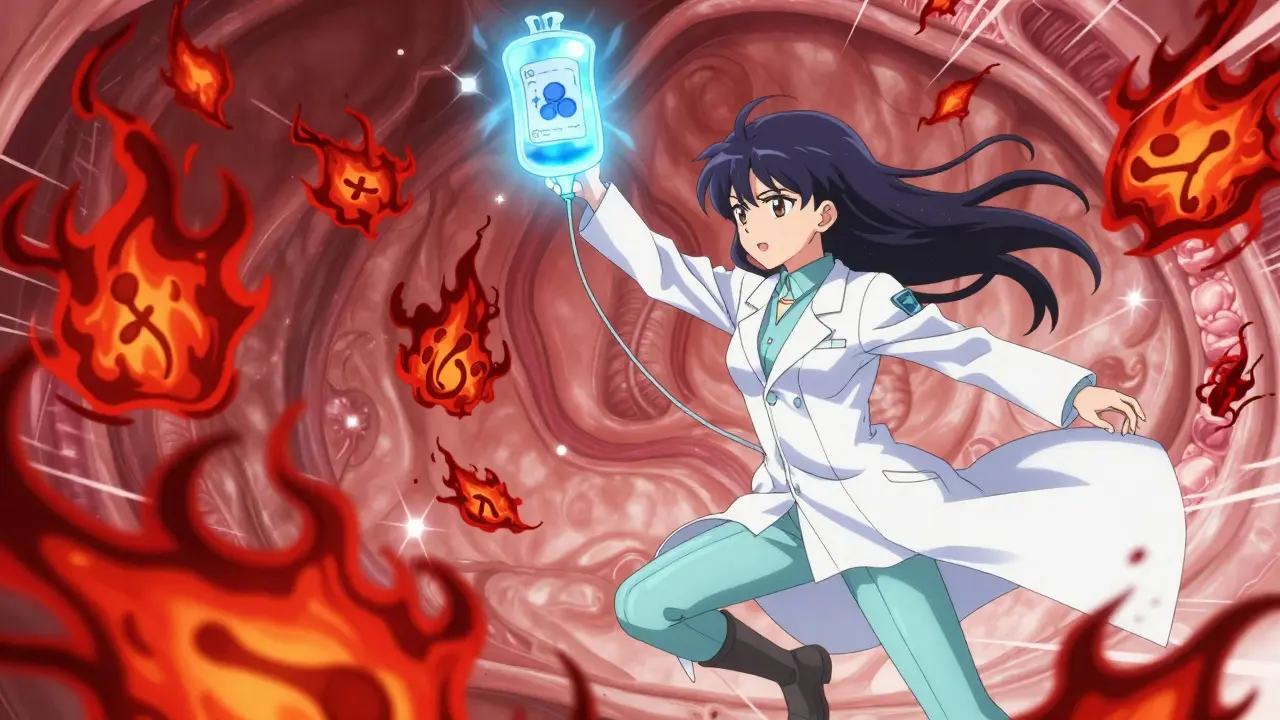
If steroids are a fire hose, biologics are a precision laser. These drugs target specific pathways involved in TED rather than shutting down the entire immune system. The biggest breakthrough here is Teprotumumab, sold under the brand name Tepezza®.
Approved by the FDA in January 2020, Teprotumumab is a monoclonal antibody that blocks the IGF-1 receptor. Why does this matter? Because IGF-1 receptors are overexpressed in the orbital tissues of TED patients. By blocking them, Teprotumumab stops the production of those water-absorbing glycosaminoglycans and halts fat cell growth at the source.
The results in clinical trials were striking. In the OPTIC trial published in the New England Journal of Medicine, 71% of patients taking Teprotumumab saw their proptosis reduce by at least 2 mm, compared to only 20% on placebo. Even more impressive, 59% experienced improvement in double vision versus 26% in the placebo group. The standard course involves eight infusions over six months.
But there are caveats. Cost is the elephant in the room. A full course costs approximately $360,000 in the US. While insurance coverage varies, prior authorization delays average 47 days, and 42% of patients report initial denials. Side effects include muscle spasms (24%), hearing changes (11%), and hyperglycemia (8%). The FDA issued a boxed warning regarding hearing impairment and infusion reactions, so monitoring is essential.
Another biologic, Satralizumab (Enspryng®), received FDA approval in 2023. It targets the IL-6 receptor and offers a subcutaneous injection alternative for patients who don’t respond to steroids. Phase III data showed a 54% response rate for proptosis reduction. It provides another arrow in our quiver for steroid-refractory cases.
Comparison: Steroids vs. Biologics
| Feature | IV Methylprednisolone (Steroids) | Teprotumumab (Tepezza®) |
|---|---|---|
| Mechanism | Broad immune suppression | Targeted IGF-1 receptor inhibition |
| Response Rate (Proptosis) | ~40-50% | 71% (≥2mm reduction) |
| Response Rate (Diplopia) | Variable | 59% improvement |
| Administration | IV Infusion (12 weeks) | IV Infusion (8 doses over 6 months) |
| Key Side Effects | Weight gain, glucose intolerance, osteoporosis risk | Muscle spasms, hearing changes, hyperglycemia |
| Cost Barrier | Low | High ($360k/course in US) |

When Medication Isn't Enough: Surgery and Supportive Care
Not everyone responds to drugs. About 35% of TED patients still require surgery despite medical therapy. But surgery is almost always delayed until the inactive phase. Operating on inflamed, unstable tissue leads to poor outcomes and unpredictable scarring.
The surgical sequence typically follows this order:
- Orbital Decompression: Removing bone or fat from the orbit to create space for the eye to sit back. This reduces proptosis by 2-5 mm. Risks include new-onset double vision (15%) and sinusitis (8%).
- Strabismus Surgery: Adjusting the eye muscles to correct double vision. Prisms in glasses can help mild cases (up to 15 prism diopters), but severe misalignment needs surgical correction.
- Eyelid Surgery: Tightening lids that have retracted due to scar tissue, helping protect the cornea and improve appearance.
For mild TED, supportive care is key. Artificial tears (preservative-free sodium hyaluronate) help 85% of patients within four weeks. Selenium supplementation (200 mcg daily) shows modest benefit in quality of life, according to a 2020 Cochrane review. And perhaps most importantly: quit smoking. Smoking increases the risk of developing TED by 7.7-fold and makes treatments significantly less effective.
Navigating Treatment Decisions
Choosing between steroids, biologics, or watchful waiting depends on your specific case. Here is a quick decision framework based on current guidelines:
- Mild TED (CAS <3): Focus on supportive care. Use artificial tears, selenium, and sunglasses. Monitor closely for progression.
- Moderate-to-Severe Active TED (CAS ≥3): Start IV steroids or Teprotumumab immediately. Time is tissue. Early intervention prevents permanent structural changes.
- Sight-Threatening TED: This is an emergency. Optic neuropathy or corneal breakdown requires high-dose IV steroids and possibly urgent orbital decompression surgery to save vision.
- Inactive Phase: Medical therapy stops. Evaluate for reconstructive surgery if functional or cosmetic issues remain.
Access remains a hurdle. In the UK, NHS access to Teprotumumab is limited and often restricted to severe cases due to cost-effectiveness reviews. In the US, insurance battles are common. Don’t hesitate to ask your doctor for assistance programs or prior authorization support. The delay in getting treated can worsen outcomes.
Can Thyroid Eye Disease go away on its own?
Mild cases may stabilize without major intervention, but the active inflammatory phase typically lasts 6-24 months. Without treatment, inflammation can lead to permanent scarring, muscle stiffness, and vision loss. It rarely "goes away" completely without leaving some structural changes, which is why early treatment is recommended to minimize long-term damage.
Is Tepezza covered by insurance?
Coverage varies widely. In the US, many commercial plans cover it after prior authorization, but Medicaid coverage is limited. Approximately 42% of patients report initial insurance denials. Assistance programs exist through the manufacturer (Amgen/Horizon Therapeutics) to help with costs, but navigating the bureaucracy can take weeks.
How long does it take for steroids to work for TED?
Patients often report symptom relief, such as reduced pain and swelling, within 2-4 weeks of starting IV methylprednisolone. However, the full course usually lasts 12 weeks to ensure the inflammation is fully suppressed and to prevent relapse during the tapering process.
Does smoking really make TED worse?
Yes, dramatically. Smoking increases the risk of developing TED by nearly 8 times. More importantly, smokers respond significantly worse to both steroid and biologic treatments. Quitting smoking is the single most impactful lifestyle change you can make to improve your prognosis.
When is orbital decompression surgery necessary?
Surgery is considered if medical therapy fails to control proptosis or double vision, or if there is sight-threatening optic neuropathy that doesn't respond to steroids. It is typically performed during the inactive phase (after 6-12 months of stability) to ensure predictable results and reduce the risk of complications.