 Jun, 20 2026
Imagine this: your child has a fever, and the doctor prescribes a liquid antibiotic. The bottle says "give 5 mL every 8 hours." You grab a kitchen spoon from the drawer, scoop up the medicine, and hand it to your little one. It feels right. But here is the hard truth-that kitchen spoon might actually hold 7 mL or only 3 mL. That difference could mean your child gets too much medicine, risking side effects, or too little, leaving the infection untreated.
This isn't just a hypothetical scenario. According to the Consumer Medication Safety Institute, roughly 7 in 10 people measure liquid medicine incorrectly at home. For adults, an error might be annoying. For children, whose bodies are smaller and more sensitive, a dosing mistake can lead to serious harm or even hospitalization. The Centers for Disease Control and Prevention (CDC) launched the PROTECT initiative specifically to tackle this issue because preventing overdoses and underdoses in kids is a critical public health priority.
The good news? Getting this right doesn’t require a degree in pharmacy. It requires using the right tools and understanding a few simple rules. Let’s walk through exactly how to measure doses safely so you can treat your child with confidence.
Why Kitchen Spoons Are Dangerous
We have all been taught that a teaspoon equals 5 milliliters (mL). In cooking, that approximation works fine. In medicine, it is a recipe for disaster. Household spoons vary wildly in size. A study by Cincinnati Children's Hospital found that the average kitchen teaspoon holds between 3.9 mL and 7.3 mL of liquid. That is a huge range when you are trying to give a precise dose of medication.
Using a tablespoon instead of a teaspoon creates an even bigger gap. A standard medical tablespoon is 15 mL, but many household tablespoons hold closer to 20 mL or more. If your prescription calls for 15 mL and you use a large kitchen spoon, you might accidentally give your child nearly 30% more medicine than intended.
The American Academy of Pediatrics (AAP) and the CDC strongly advise against using any kitchen utensil for medication. They recommend eliminating terms like "teaspoon" and "tablespoon" entirely from your mental vocabulary when it comes to medicine. Instead, focus solely on milliliters. This shift in mindset is the first step toward accurate dosing.
Choosing the Right Tool: Syringes vs. Cups
Not all measuring devices are created equal. When you pick up a bottle of children's medicine, you usually get a measuring device inside. But which one should you trust?
| Tool Type | Accuracy Rate | Best For | Common Pitfalls |
|---|---|---|---|
| Oral Syringe | 94% | Doses under 5 mL; Infants and toddlers | Spitting out if placed too far back in throat |
| Dosing Cup | 76% | Larger volumes; Older children who can drink directly | Parallax error (reading from above/below); Meniscus confusion |
| Medicine Dropper | Variable | Very small doses (under 1 mL); Eye/ear drops | Hard to read markings; Air bubbles affect volume |
| Kitchen Spoon | <50% | Cooking only | Inconsistent size; Not calibrated for medicine |
The data is clear: oral syringes are the most accurate tool available. A 2020 study published in PubMed Central (PMC) involving nearly 500 parents showed that oral syringes achieved 94% accuracy, compared to just 76% for dosing cups. For small doses-anything less than 5 mL-the difference is even starker. Error rates for 2.5 mL measurements jumped to 68.5% with cups but stayed low at 12.3% with syringes.
If your child is old enough to drink from a cup without spilling, a dosing cup might be easier for larger volumes (like 10 mL or more). However, for infants, toddlers, or any dose under 5 mL, always reach for the syringe. Many pharmacies now provide color-coded syringes, such as the NurtureShot system, which have been shown to reduce errors by over 60%. If your pharmacy didn't include one, ask for one. It is worth the extra trip.
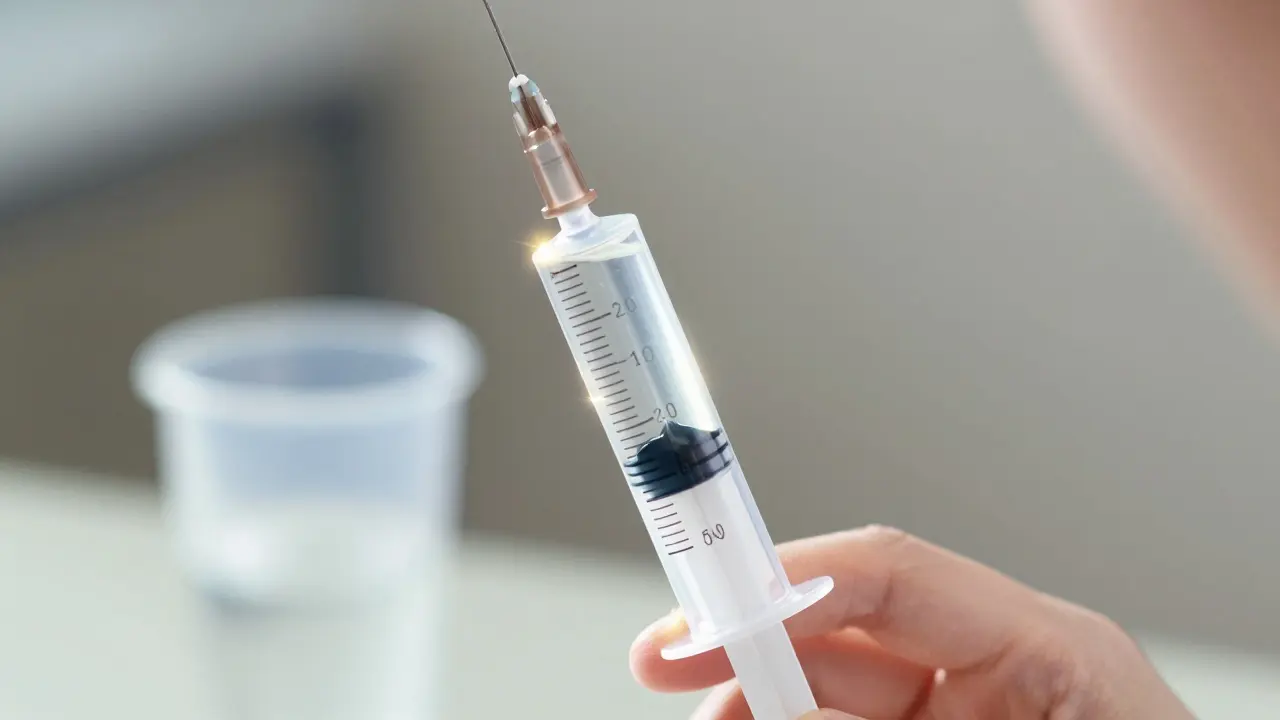
Mastering the Milliliter: Reading the Markings
Once you have the right tool, you need to read it correctly. This sounds simple, but it is where most mistakes happen. Look closely at your syringe or cup. You will see lines marked with numbers. These represent milliliters (mL).
A common and dangerous mix-up involves confusing milligrams (mg) with milliliters (mL). Milligrams measure weight (how strong the medicine is), while milliliters measure volume (how much liquid you pour). Dr. Matthew Grissinger from the Institute for Safe Medication Practices notes that this confusion accounts for about 36% of all reported liquid medication errors. Always check your prescription label. It should say something like "Give 5 mL" not "Give 5 mg." If you are unsure, call your pharmacist immediately.
When reading the measurement, follow these steps:
- Hold it vertically: Keep the syringe or cup upright. Tilting it changes the level of the liquid.
- Eye level is key: Bring the tool up to your eyes. Looking down from above makes the liquid look higher than it is. Looking up from below makes it look lower. This is called parallax error, and it is a major reason why dosing cups fail.
- Read the meniscus: Liquid curves slightly at the edges in a container. This curve is called the meniscus. For water-based medicines, read the bottom of the curve. Make sure the bottom of the curve aligns perfectly with the number line for your dose.
- Check for air bubbles: If you are using a syringe, tap it gently to move any air bubbles to the tip before pushing them out. Air takes up space, meaning you might think you have 5 mL of medicine when you actually have 4.5 mL of medicine and 0.5 mL of air.
Understanding Weight-Based Dosing
Children's medicine is rarely "one size fits all." Doctors often prescribe doses based on your child's weight, not their age. This is because a heavy 5-year-old needs more medicine than a light 5-year-old. The prescription might say "40 mg/kg/day," which means 40 milligrams per kilogram of body weight per day.
To calculate this yourself (or verify what the doctor said), you need to convert pounds to kilograms. The formula is simple: divide the weight in pounds by 2.2.
For example, if your child weighs 22 pounds:
- 22 lbs / 2.2 = 10 kg
- If the dose is 40 mg/kg/day, the total daily dose is 400 mg.
- If the medicine is split into two doses, each dose is 200 mg.
- If the bottle concentration is 400 mg per 5 mL, then 200 mg equals 2.5 mL.
You don't need to do this math every time if your doctor provides the exact mL amount. But understanding the logic helps you spot errors. If the label says "Give 10 mL" for a tiny infant, something is wrong. Trust your gut, and double-check with your pharmacist if the number seems off.

Practical Tips for Giving Medicine
Even with perfect measurement, getting the medicine into your child's mouth can be a battle. Here are some strategies that work:
- Shake well: Suspensions (like many antibiotics) settle at the bottom. If you don't shake the bottle thoroughly before every dose, you might give mostly water first and concentrated medicine last. This leads to inconsistent dosing.
- Aim for the cheek: When using a syringe, place the tip along the inside of your child's cheek, near the back molar. Do not aim for the throat, as this can trigger a gag reflex. Squeeze the plunger slowly.
- Mix with food (with caution): Some medicines can be mixed with a small amount of applesauce or pudding. Check with your pharmacist first, as some drugs interact with certain foods or lose effectiveness. Never mix the entire bottle with food, as your child may not finish it.
- Use a marker: If you are giving the same dose repeatedly, use a permanent marker to draw a line on the syringe barrel at the correct level. This visual cue reduces anxiety and errors during stressful moments.
What to Do If You Make a Mistake
Parents are human. We get tired, distracted, and overwhelmed. If you think you gave too much or too little medicine, stay calm. Do not induce vomiting unless instructed by a medical professional. Call your doctor or the Poison Control Center (1-800-222-1222 in the US) immediately. Have the medicine bottle ready so you can tell them the exact name, strength, and estimated amount given.
Prevention is better than cure, though. Keeping a consistent routine, using the same tool every time, and educating all caregivers (grandparents, babysitters) on proper technique can drastically reduce errors. Remember, the goal is safety. Taking an extra minute to measure correctly is the best gift you can give your child's health.
Can I use a kitchen teaspoon for my child's medicine?
No, you should never use a kitchen teaspoon. Household spoons vary significantly in size, often holding anywhere from 3.9 mL to 7.3 mL instead of the standard 5 mL. This inconsistency can lead to dangerous overdoses or ineffective underdoses. Always use the oral syringe or dosing cup provided with the medication.
What is the difference between mg and mL?
Milligrams (mg) measure the weight or strength of the active ingredient in the medicine. Milliliters (mL) measure the volume of the liquid. Confusing these two is a leading cause of medication errors. Your prescription should specify the volume in mL to administer. If you are unsure, consult your pharmacist.
Which is more accurate: a dosing cup or an oral syringe?
An oral syringe is significantly more accurate, especially for doses under 5 mL. Studies show oral syringes have a 94% accuracy rate compared to 76% for dosing cups. Dosing cups are prone to parallax errors and are difficult to read precisely for small amounts. Use a syringe for infants and small doses, and a cup only for older children taking larger volumes.
How do I read the measurement on a syringe correctly?
Hold the syringe vertically and bring it to eye level. Look at the bottom of the meniscus (the curve of the liquid) and align it with the correct mL marking. Ensure there are no air bubbles in the liquid, as they take up space and reduce the actual amount of medicine. Tap the syringe to move bubbles to the tip before administering.
Should I shake liquid medicine before every dose?
Yes, if the label says "shake well." Many liquid medications, especially antibiotics, are suspensions where the solid particles settle at the bottom. Shaking ensures the medicine is evenly distributed throughout the liquid. Failing to shake can result in giving too little medicine at first and too much later.
What should I do if I accidentally give too much medicine?
Stay calm and contact your healthcare provider or the Poison Control Center (1-800-222-1222 in the US) immediately. Have the medication bottle handy to provide details about the drug name, strength, and estimated amount administered. Do not induce vomiting unless explicitly instructed by a medical professional.